AirBnB Boutique Hotels: Beating the Odds
 I've wanted to get into AirBnBs for years, but Boston regulated them early. Its short-term rental ordinance, which took effect in January 2019, banned short-term rentals in units the owner doesn't live in. That shut investors out and showed me how quickly a city can take this strategy away. So in 2023 I converted my long-term rentals to mid-term instead. That same summer the internet declared the #Airbnbust, after a viral chart showed revenue per listing down 47% year over year in Phoenix and 46% in Austin. Two years later I'm buying a short-term rental in Charlotte with my own money. The work and the regulation risk are still there, but the market has changed. Some listings book at premium rates months out while others can't fill their calendars, and most of the investors who are underwater today own the second kind.
The bust was real for the average listing
The chart turned out to be wrong. Its author had grouped one vendor's county-level data into metro areas himself, and when AirDNA's chief economist reran the same revenue-per-listing analysis on AirDNA's data, the average market was down 3.6%, not 40%. Another data firm had Phoenix down 2.5%. The vendors scrape listings differently, and at least one says its system may count nights a host blocked off as booked, so it pays to check whose data a chart uses before sharing it. The squeeze was still real, just smaller. AirDNA's 2024 outlook report showed demand up 6.7% while available nights grew 12.8%, and revenue per available night fell 4.9%, which AirDNA called the industry's first drop. Anyone who bought during the 2021-22 travel boom and underwrote to those numbers was exposed. By that summer a Phoenix-area agent was telling local TV that big companies that had bought short-term rentals were selling them or converting them to long-term rentals, and Skift ran a story on how saturation was leading to a correction and "lots of home sales" in vacation markets. Occupancy settled at 54.8%, back to pre-pandemic levels, so the industry average looked fine. The average hid who was winning: the top listings kept booking while everyone else fought over what was left.
AirBnB's search changes
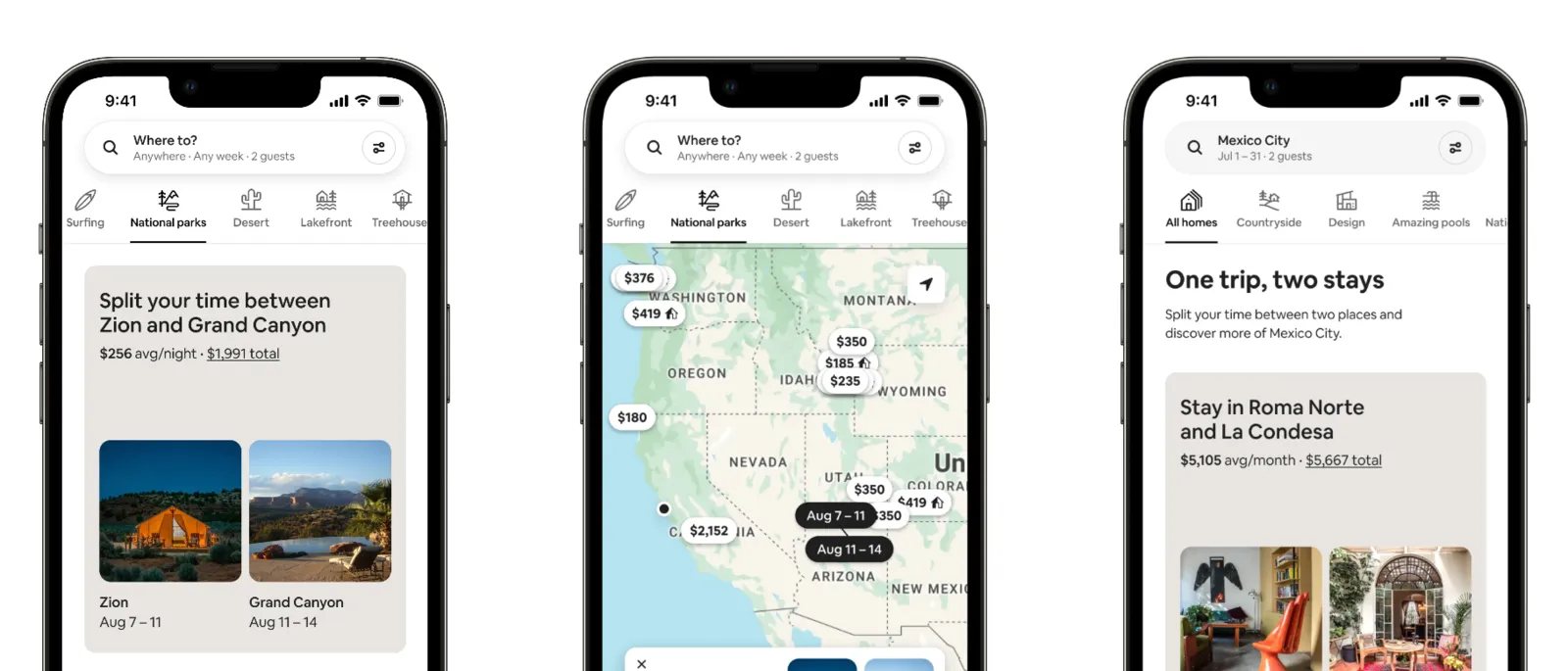 Oversupply alone would have hurt every host about equally if AirBnB's search still worked the way it did in 2019, when guests typed in a city and scrolled. In May 2022 AirBnB rolled out Categories, which it called the biggest change to the platform in a decade, so guests could browse homes by what they offer instead of by city. In November 2022 it announced it would rank search results by total price instead of nightly price, which buried listings that hid a cheap nightly rate behind a big cleaning fee. And in November 2023 it launched Guest Favorites, a badge and search filter for the 2 million homes with the best ratings, reviews and reliability (it isn't a luxury badge, over a third of them rent for under $100 a night).
Each change moved more bookings toward the listings guests rate highest. A category placement gets a listing seen, good photos get it clicked, and a good stay produces the reviews that keep it ranked. A listing that falls behind gets fewer bookings, which means fewer reviews and a lower rank, and the gap keeps growing. I don't think AirBnB set out to build a winner-takes-all system, but put a review-driven search on top of a supply glut and that's what you get.
Grandma's house doesn't work anymore
The listings that drowned are easy to spot. They look like your grandma's house, with floral bedspreads and a TV in the living room as the only entertainment. A few years ago that was enough, because guests were happy to find anything with enough beds. Today that listing sits on page three behind homes with a hot tub in the thumbnail, and from the comps I've looked at, it earns about a third of what the same house would as a boutique hotel. A friend who researched this market before me talked to an investor who runs a 16-sleeper in Scottsdale. His take on the hosts complaining on Reddit about getting priced out was that they "lacked any sophistication in their property." They designed the house for themselves instead of the guest.
The listings that do well now are large homes that can host big multi-generational families, usually sleeping 16 to 20 people. Sleeping 20 takes more than bedrooms: the dining table has to seat everyone and the living room has to work with 20 people in it. Hotels are bad at this (nobody wants a family reunion split across six rooms on three floors), and as the Scottsdale investor put it, "higher number of people is where AirBnBs outperform hotels." These houses also have plenty to do inside, like a hot tub, a game room or a playground for the kids, so the group doesn't need to go anywhere else.
Amenity stuffing
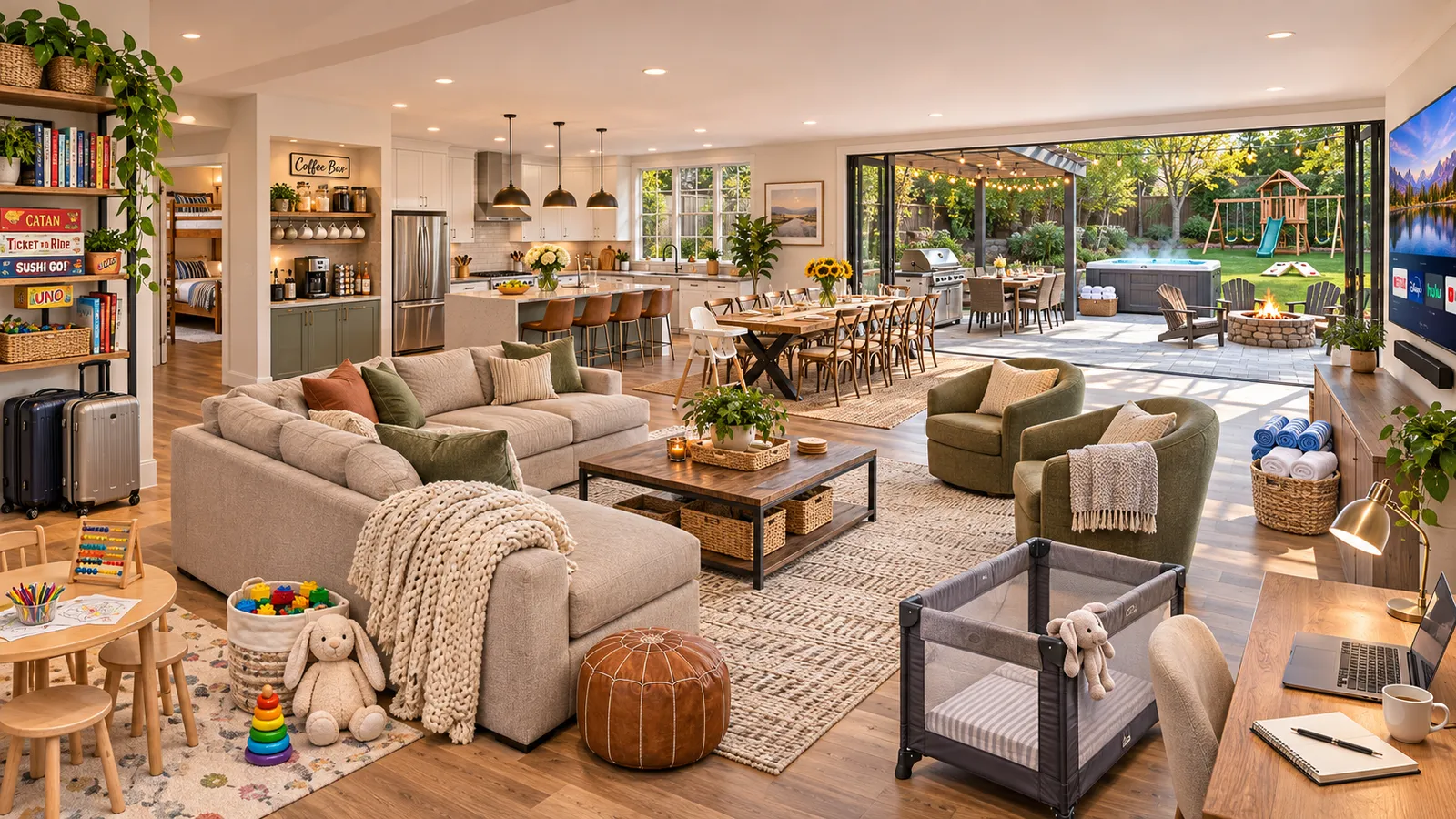 The strategy is amenity stuffing: buy a large house, design it around a specific guest, and pack it with enough to do that the property becomes the reason for the trip. The designer we've been talking to starts every project from a "guest avatar" (say, three generations of one family with young kids) rather than a style, and the avatar decides everything from the paint to the amenity list. In Charlotte, a well-designed 5-bedroom books at $450-550 a night, roughly $7k a month across the year with September as the slow month. That's 2-3x what the same house would rent for long-term. Amenities carry their own premium, but it depends on the market. AirDNA found that full-time 3-bedroom homes with a pool average $355 a night, a 29% premium over similar listings without one. The revenue lift ranged from 73% in Fort Walton Beach to 12% in Myrtle Beach, and cold or rural markets saw little to none. Charlotte isn't a beach town, which is why we're prioritizing a hot tub and a game room over a pool. The Scottsdale investor admitted his biggest obstacle was his own instinct as a buyer: "Anytime I buy a property, I have mental barriers... 'I don't need a pool'... But when I think about it as an investment... it's a business."
This was a big shift for me. In Boston I lived by the 1% rule (monthly rent of at least 1% of the purchase price), which I could hit with triplexes in C+ areas but never with new construction. Then a friend showed me his new 5-bedroom, bought at $740k and grossing $7k a month on AirBnB (0.95%, close enough). I initially thought buying new was a bad idea until I ran through his numbers. One gotcha to note: the 1% rule is usually paired with the 50% rule, which assumes about half the rent goes to expenses, and a short-term rental spends a lot more on utilities, supplies, a co-host and hot tub maintenance. A short-term rental at 1% makes far less than a triplex at 1%, and I suspect that's how a lot of 2021 buyers ended up underwater.
Size alone won't protect a listing for long, because other investors are reading the same playbook and buying big houses too. Amenities are going the same way. Skift calls it an "amenities arms race", quoting a supplier who remembers when you could "grab a three-bedroom, two-bath, throw an air mattress and a hot plate in it, throw it up on Airbnb and make a bunch of money." Our designer counted 116 five-bedroom listings in our Charlotte comp set. Above 100 she designs to stand out, and below 100 she does it anyway, "because eventually the market will get to be > 100." The next host can copy a hot tub or a bunk room in a weekend. A house designed around one guest, with a long run of five-star reviews behind it, takes a lot longer to copy.
Why we brought in partners
Most of the underwater stories I've read follow the same pattern: the owner bought on 2021 comps, furnished the house over a weekend, and self-managed with a lockbox and a cleaning app. I've written about the problems with turnkey operators before, and I fired my own property manager once he got too big to care about my properties. So we were picky. The team we're working with in Charlotte has already run this playbook for other investors, including the friend whose house is my comp. Their agent also handles design, setup and co-hosting, and the co-host is paid a percentage of gross, so they only make money if the property books.
The process has four steps: pre-qualify, search with AirDNA and PriceLabs against a conservative pro forma, make an offer (in North Carolina that means a due-diligence fee plus earnest money), then design and set up the house before handing it to the co-host. According to the agent, most clients are live and booking within 75 days. We're doing this first deal with our own money as a test run. If it works, it becomes another strategy in the Investomation toolkit, and the lazy money investors I talk to get a way into short-term rentals without having to learn a new trade.
The $250k plan
Beyond the down payment and closing costs, the agent's budget is about $15k for design ($6-7 per square foot), $25-30k for a contractor, and roughly $8k of furniture per bedroom, about $60k for a 5-bedroom. The target is around $250k all in, which at 20% down fits a $600-650k house. My own buy box is under $700k with no HOA, no flood zone, and a garage we can turn into a game room. I care about cash flow first and appreciation second, and the goal is $10k a month across four to six houses before we try this in other markets.
What could go wrong
- Regulation. The Scottsdale investor called it "a one-way gate, and it's a boolean." A city that bans short-term rentals rarely un-bans them, and Boston hasn't. North Carolina law bars cities from requiring a permit or registration to rent out a property, and in 2022 the state Court of Appeals used it to throw out Wilmington's short-term rental registration, along with the rental cap and distance rules tied to it. That makes NC friendlier than most states, but zoning still applies and laws change.
- Holding costs. The agent warned that the more amenities we add, the longer setup takes, and every month of setup is a mortgage payment with no income against it.
- The exit. If AirBnB stops working, the fallbacks are a long-term rental or a sale. At today's rates, long-term rent on a $600k house won't cover the mortgage, so renting it out only slows the bleeding while we wait to sell. The real floor is selling in a metro that keeps growing.
- Parties and damage. Guests sign a short-term rental agreement with a no-party clause, and the co-host documents the house at every check-in and check-out so damage claims hold up.
I'll report back once the first house is live and we see whether the 75-day timeline holds.
Want the underwriting kit behind this plan? The buy box, the full $250k budget, a three-scenario pro forma and the long-term rental fallback math are available to our Professional members.
