Blockchain Bridges: Connecting Fractured Ecosystems
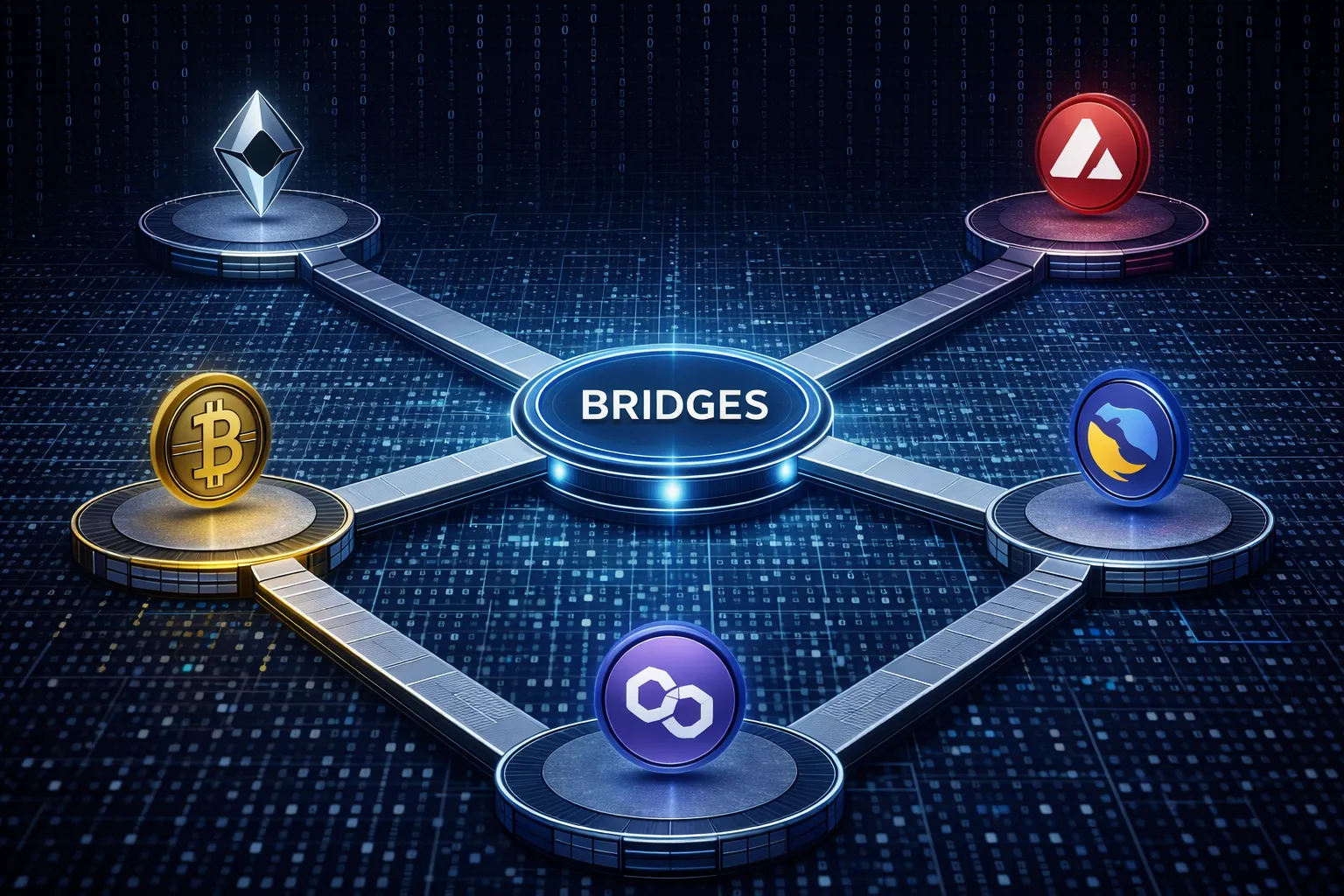 Blockchains today operate as isolated networks (“silos”) with distinct assets and users. Many are compatible with Ethereum, but that doesn't mean funds can magically jump from one to the other. To move the funds across, we need a bridge.
Bridges allow tokens and data to move across networks. For example, let's say you want to use a fraction of your Bitcoin to fund a transaction on Ethereum network. Historically, you wouldn't be able to, or at least not easily. You would need to move your assets into traditional brokerage, then sell BTC and buy ETH (resulting in a taxable event), and now Uncle Sam wants a cut simply because you moved your own funds from one wallet to another. Bridges solve this problem, they allow you to dock your assets on one network, and redeem a voucher for them on another network.
How Bridges Work
Most bridges use a “lock-and-mint” (and reverse “burn-and-unlock”) model. In simple terms, when you move a token “from” Chain A “to” Chain B, the bridge locks (or burns) that token on A and mints a new, pegged token on B. This ensures total supply stays constant. (Later, burning the token on B unlocks the original on A.) This model concentrates value in the bridge’s contracts, so security is vital.
Bridges differ in their technical design and trust model. Some are trusted/federated bridges: a centralized party or a quorum of validators controls the asset movements. For example, early bridges like Binance’s own ETH-BNB bridge is run by a fixed federation that users must trust. Others are trustless bridges that rely on decentralized mechanisms (smart contracts, multi-signature schemes, or threshold signatures) so no single entity holds custody. For instance, Connext and Hop are modern “trustless” bridges built on verifiable cross-chain messaging.
In practice, many bridges use multi-signature or oracle-style validators. Wormhole (connecting Solana↔Ethereum) uses a set of “guardian” nodes (usually top Solana validators) to watch both chains. When a token lock is observed on one chain, at least 2/3 of the guardians must sign off before the counterpart token is minted on the other. Similarly, Synapse (a cross-chain liquidity network) employs a threshold signature scheme: each transfer must be signed by two-thirds of its MPC validator set. Avalanche Bridge (Avalanche↔Ethereum) uses a secure enclave and four “warden” services (run by Ava Labs, Avascan, Halborn, etc.). Three of the four must report a transfer before it proceeds, protecting against any single point of failure. Bridges coordinate off-chain verifiers to attest that events on one chain are valid before minting or releasing assets on the other.
Different bridges also handle assets differently. Some treat the same token from two chains as distinct tokens on the target chain. For example, Harmony’s Horizon Bridge mints ethUSDT when bridging USDT from Ethereum, and bscUSDT when bridging USDT from Binance Smart Chain, even though both represent USDT. (This simplifies the bridge logic but requires liquidity pools if users want to swap between these bridged variants.) Other designs attempt a single unified token on the target chain, but that is more complex to secure.
Bridge Categories
Bridges can be classified by what they connect and how they operate:
What Do They Connect?
- Cross-Chain (L1↔L1) bridges connect different base layer blockchains (e.g. Ethereum↔Avalanche, Ethereum↔Solana, etc.). Examples include the Avalanche Bridge, Ethereum↔Polygon bridges, and Wormhole.
- L1–L2 or L2–L2 bridges link Ethereum with its layer-2 chains (e.g. Optimism, Arbitrum) or connect rollups to each other.
- Intra-Ecosystem bridges: Some networks have built-in multi-chain architectures. For example, Polkadot’s Relay Chain and XCMP (cross-chain message passing) let its parachains interoperate natively, so no external bridge is needed within Polkadot. Avalanche natively supports multiple built-in chains (X-Chain, P-Chain, C-Chain) and allows anyone to run a custom subnet (app-specific chain). These subnets can still “teleport” assets to the main Avalanche chains. (A notable example: the DeFi Kingdoms game launched its own “Jade” Avalanche subnet to run the game, with the DFK team bridging its JEWEL token between Avalanche and Harmony.)
Trustless vs Custodian
Based on trust/security, bridges are either trusted (users hand assets to a centralized operator) or trustless (assets stay in protocol-controlled contracts, guarded by code or decentralized oracles). Over time the industry has been moving toward trustless designs, but federated bridges still exist.
Mechanism
Finally, bridges can be categorized by their asset-transfer mechanism. The common categories are:
- Lock-and-mint (burn-and-release): e.g. lock native ETH on Ethereum, mint wrapped ETH on Avalanche. (Used by Polygon’s PoS bridge, Avalanche Bridge, many others.)
- Burn-and-mint: Destroy a token on the source chain and create on the destination. This is similar to lock/mint but uses burn rather than lock.
- Atomic swap bridges: These use atomic-swap style contracts to directly exchange tokens between chains without custodial locking. In practice this is more theoretical across different L1s (it works when both chains support compatible contracts).
- Liquidity-network bridges: Recent designs (like Synapse or Thorchain’s approach) incorporate cross-chain AMMs or solver networks: the bridge may mint a placeholder token and immediately swap it via a liquidity pool so users end up with a native asset on the target chain.
Notable Bridges (Launch Dates & Builders)
 Several high-profile bridges were live by 2021:
- Harmony Horizon Bridge (Oct 2020) – Builder: Harmony Protocol. This was one of the first cross-chain bridges connecting Ethereum↔Harmony. (Harmony later added Binance Smart Chain support.) It uses lock/burn flows: e.g. locking ETH/ERC‑20 on Ethereum and minting HRC‑20 equivalents on Harmony.
- Binance Smart Chain Bridge (Mar 2021) – Builder: Harmony. Announced March 2021, this bridged BEP-20 tokens from BSC into Harmony (via the same Horizon infrastructure). It minted distinct tokens (bscUSDT vs ethUSDT) for assets coming from different chains.
- Polygon (Matic) Bridges – Builder: Polygon (previously Matic) team. Polygon’s PoS network launched mid‑2020 with native Ethereum interoperability. It had two official bridges to Ethereum: a Plasma Bridge (live since 2019) and a newer PoS Bridge (launched around 2020–2021). Both are trust-minimized smart contracts. The Plasma bridge is slower but “more secure” (seven-day withdrawal security), while the PoS bridge is faster for day-to-day transfers. These bridges let users lock ETH, ERC‑20 or NFTs on Ethereum and mint equivalents on Polygon. (As Immunefi reports noted, Polygon’s Plasma bridge at one point held nearly $850M and had a critical bug discovered by a whitehat in Oct 2021.)
- Avalanche Bridge (July 2021) – Builder: Ava Labs. The official Avalanche–Ethereum Bridge (AB) launched July 2021 (an upgrade of an earlier early‑2021 bridge). AB uses an Intel SGX enclave and four “warden” observers to verify transfers. It dramatically reduced fees and improved security over the prior bridge. AB lets users move ETH and many ERC‑20s onto Avalanche C-Chain (minting wrapped tokens) and back again by burning on one chain and unlocking on the other.
- Wormhole (Oct 2020) – Builder: Certus One / Jump Crypto. Initially launched Oct 8, 2020 (with support for ETH⇄Solana tokens), Wormhole established the first bidirectional bridge between Ethereum and Solana. Its “guardian” nodes (cross-chain oracles including top Solana validators) watch each chain: when they see tokens locked on Chain A, a 2/3 quorum of guardians signs a VAA (validator action approval) that mints tokens on Chain B. By late 2021 Wormhole had been extended to multiple networks (Terra, BSC, etc.) and became a general cross-chain messaging layer.
- Synapse Protocol (Aug 2021) – Builder: Synapse (ex‑Nerve Protocol team). Launched August 28, 2021, Synapse is a cross-chain “liquidity network” originally spun out of the Nerve stable-swap project on BSC. It added stablecoin bridges connecting Ethereum, Avalanche, BSC, Polygon, Fantom, etc. Synapse’s network is secured by MPC validators (threshold signatures): on each transfer, 2/3 of the validator nodes must attest to the lock event before minting occurs on the destination. Uniquely, Synapse also integrates a cross-chain AMM: when Synapse mints a bridged token (e.g. nETH on Avalanche), its internal AMM can automatically swap that for the local native token via liquidity pools. This means end users can often receive “native” assets on the target chain seamlessly. Synapse quickly grew to be one of the most-used bridges (on track for billions in volume), and even survived an attempted exploit in Nov 2021 where a crafty attacker tried to manipulate its nUSD pool.
Novel Designs and Trends
The space is rapidly innovating. Beyond basic token bridges, new protocols and designs are emerging:
- Cosmos IBC (Mar 2021) – The Cosmos ecosystem introduced Inter-Blockchain Communication (IBC) in March 2021interchaininfo.zone. IBC is essentially a standardized, trust-minimized message and transfer protocol for any Cosmos-SDK chain. It uses light clients and relayers (similar in spirit to bridges but built into the network) to move tokens and data securely. IBC has since been adopted by dozens of chains (and even projects like NEAR, Solana via adaptersinterchaininfo.zone), proving the concept of a “router” for blockchains.
- Polkadot’s XCMP/XCM – Polkadot is building its own cross-consensus messaging (XCMP) to let parachains send arbitrary messages (and tokens) trustlessly. By 2021 this was still under development, but it represents a future where an entire ecosystem has native interoperability without external bridges.
- Liquidity-Driven Bridges – Synapse’s integration of AMM liquidity is an example of bridges evolving into full cross-chain DeFi rails. Other projects (like Thorchain or layer-2 hop bridges) were exploring incentivized liquidity pools or solver networks to fulfill cross-chain transfers faster and with less trust.
- Unified Messaging Layers – Several teams announced general “cross-chain messaging” layers (e.g. LayerZero, Axelar) that aim to connect any chains with minimal custom work. These ideas combine on-chain programs and off-chain relayers for maximal flexibility. As of late 2021 they were mostly in testnets or development.
The line between “bridge” and “messaging/utility layer” is blurring. The trend is toward more decentralized, generalized interoperability solutions. But all share the goal: enable seamless cross-chain value transfer.
Security and Risk Considerations
Bridges dramatically increase attack surface, and by late 2021 this was painfully obvious. According to industry reports, over 60% of major DeFi hacks were bridge-related, with losses in the billions. Because bridges hold large locked funds, they are lucrative targets. For example, in Oct 2021 Immunefi reported a critical flaw in Polygon’s Plasma Bridge that could have allowed $22 million theft (thanks to a white-hat), and MultiChain/Anyswap bridges had millions drained in mid-2021. In Nov 2021, a smart attacker gamed Synapse’s curve-based nUSD pool and got $8M of nUSD, though the team blocked the cross-chain transfer and planned to reimburse providers. Even well-known bridges like RenVM have faced exploits (e.g. in May 2021 RenBridge was drained for $35M after a key was compromised).
These incidents underline that bridges are complex: smart contracts, oracles, cross-chain consensus, and often hardware (SGX) all need rigorous security. A single flawed contract or key can expose enormous value. Thus, while bridges unlock new opportunities, users must exercise caution. Industry best practices (multisig decentralization, audits, bug bounties, insurance funds) are evolving to mitigate these risks.
