Cryptocurrencies by Use Case
I've already written a blog post explaining why cryptocurrencies are a new asset class that's here to stay. In this blog post I want to focus on the major players from utility perspective, discussing concrete use cases rather than hype surrounding many of the projects today. Since this is a real-estate blog, I will try to simplify the concepts in a way that would be familiar to the real estate crowd. Just like real estate has different niches (commercial, multi-family, land investing), so do cryptocurrencies.
Transactional Networks

Bitcoin (BTC)
Bitcoin is the original cryptocurrency. There have been many predecessors that tried to decentralize money taking away control from the banking institutions, but Bitcoin was the first that succeeded. It has now positioned itself as the "digital gold", but its true value doesn't come from trying to replace gold. Instead, a better analogy is the gatekeeper asset for other crypto. Bitcoin is already decently-well integrated into our financial system, and in order to participate in the crypto market, you will probably have to move your assets through the Bitcoin network. Bitcoin is the NYC of all other crypto, all roads lead to it, it's the safest place to store your assets off-chain.
Monero (XMR)
Bitcoin has a public ledger, that means every transaction creates a paper trail. While that's a great quality for auditing, it presents a bit of a problem when you want to keep your transactions private. The big use case for Monero is anonymity. It's the crypto-equivalent of handing someone cash in an envelope. And while on the surface it seems like the only use case for this would be illegal activity, remember that what's legal is highly subjective and varies by country. Bitcoin lets you circumvent traditional financial system, Monero lets you do so without scrutiny from the government.
Computational Networks
 Bitcoin gave us the ability to represent financial transactions using ones and zeroes. Now that we can represent financial transactions digitally, in a language consistent across the world, we could also add triggers on top that react to transactions. These triggers are called smart contracts, they're the transistors of the cryptocurrency world, allowing us to build complex operating systems that run on top of the network.
Ethereum (ETH)
The most well-known general purpose computational network is Ethereum. It's effectively money with rules. These rules can be used to model common financial operations without expensive middlemen that traditional financial systems force upon us. Using Ethereum we can build algorithms that function like escrow without a bank, markets without brokers, and loans without loan officers. Ethereum has already demonstrated this through its DeFi (Decentralized Finance) ecosystem.
The main problem with Ethereum, however, is its own success. Just like Bitcoin, Ethereum has become the Manhattan of DeFi, with Manhattan-like congestion. When the city is packed, everything costs more and moves slower. If you’ve ever tried to drive through downtown at rush hour, you already understand Ethereum fees: the system prices traffic.
Binance (BNB)
Binance is a master-planned city owned by one developer. It has clean streets, low tolls, faster permits, everything is great as long as you agree with the benevolent dictator. Binance was a solution to Ethereum's congestion problem by a centralized entity. It has an active DeFi ecosystem (nowadays more active than Ethereum), but at the end of the day it's not a true cryptocurrency. It's more of a Ethereum protocol running in single-player. It can run all the apps Ethereum can, but the security/safety just isn't there.
[!note] See Blockchain Trilemma article for a more in-depth explanation on this.
Solana (SOL)
Ethereum's main bottleneck is its approach to settling transactions. Solana uses a different approach, called proof-of-history. Rather than rejecting new transactions until old ones settle, Solana timestamps all transactions allowing the network to settle multiple transactions at once. It's the difference between forcing everyone to stand in line and issuing everyone a boarding pass ahead of time. I'm a big proponent of Solana ecosystem and believe it has the potential to eventually overtake Ethereum.
Computational Scaling (Layer 2)
 Layer 2 is basically an "express lane" on top of an otherwise congested network (usually Ethereum).
Core idea:
- take credit for multiple transactions performed on the layer 2 network
- bundle them up into one large transaction
- sync that transaction back to Ethereum
Going back to our traffic analogy, Layer 2 is effectively like using a bus in an HOV lane. Bundling multiple transactions together allows these networks to save on fees and also pay higher premiums to the parent network to prioritize these transaction. Over time these networks also gain trust, allowing parties to act upon transactions happening on these networks directly rather than waiting for them to settle on Ethereum network. This is called optimistic rollups, and the best way to think of them is like an auditor that only needs to verify that you boarded the bus, not that the bus arrived at the destination. One of the most popular layer 2 solutions is Polygon, with Arbitrum and Optimism being two other ones in the works.
Another way of looking at the service that Layer 2 networks provide is through the lens of the banking system we have today. The SWIFT network allows you to wire transactions between banks for a fee of $30-50. This wire takes 24 hours to clear. Think of this SWIFT clearinghouse as Ethereum network. It's useful for transferring money between different banks, but is slow and expensive. On the other hand, if you're transferring money to another account within the same bank, the transaction is usually instant and free. The bank can simply update its internal ledger without going through SWIFT. The bank is effectively acting like a Layer 2 network on top of SWIFT.
Layer 2 networks, however, are not without risk. They function by bridging assets to the parent network. This bridge can become a single point of failure (if our bus gets into an accident, it affects every passenger onboard).
Oracles
 Cryptocurrencies have no interaction with the outside world aside from the transactions triggered by network participants. This means that a network has no idea what the current treasury yield curve is, or who is the current president, networks live in a vacuum. Oracles bring real-world facts onto the chain.
ChainLink
ChainLink is the unsung hero of the cryptocurrency world, it's the largest and most reliable oracle. Think of it like the appraiser that compares your house to other recent sales before the lender will be comfortable using it as a collateral.
Utility Infrastructure / Sharing Economies
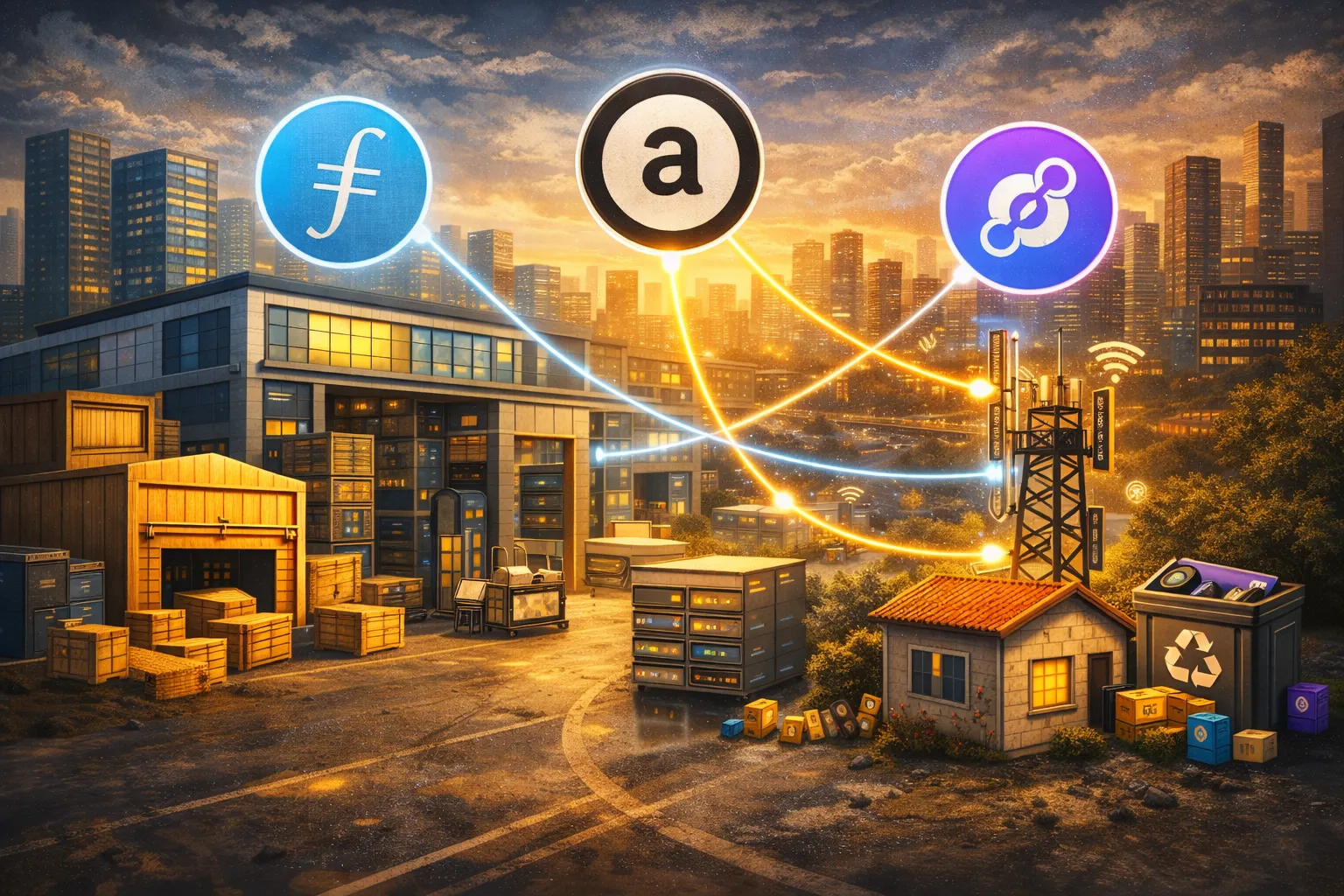 These networks use cryptocurrencies to "tokenize" a real-world resource, allowing the creation of on-chain sharing economy. It's a cool concept, akin to AirBnB for what would otherwise be an unsharable resource.
FileCoin (FIL) / Arweave (AR): Decentralized Storage
Think of this like a warehouse for your data, but instead of a single large landlord, the warehouse is owned by multiple small operators. You can store your stuff there knowing that you'll be able to retrieve it later, but may not know yourself where it's actually stored. It's up to the protocol to find your stuff later and deliver it back to you. In a way, FileCoin is the courier and the storage is provided by individuals with excess capacity.
Helium (HNT): Community-Built Wireless Network
People host hotspots, network pays them based on uptime + utilization. Similar concept to FileCoin, but instead of renting storage, you rent out your excess WiFi. Who's the consumer, you might ask? Anyone who needs low-bandwidth data and doesn't want to pay $50/mo to Comcast for it (e.g. landlord wanting to transmit data from IoT devices in their rental).
DeFi Applications
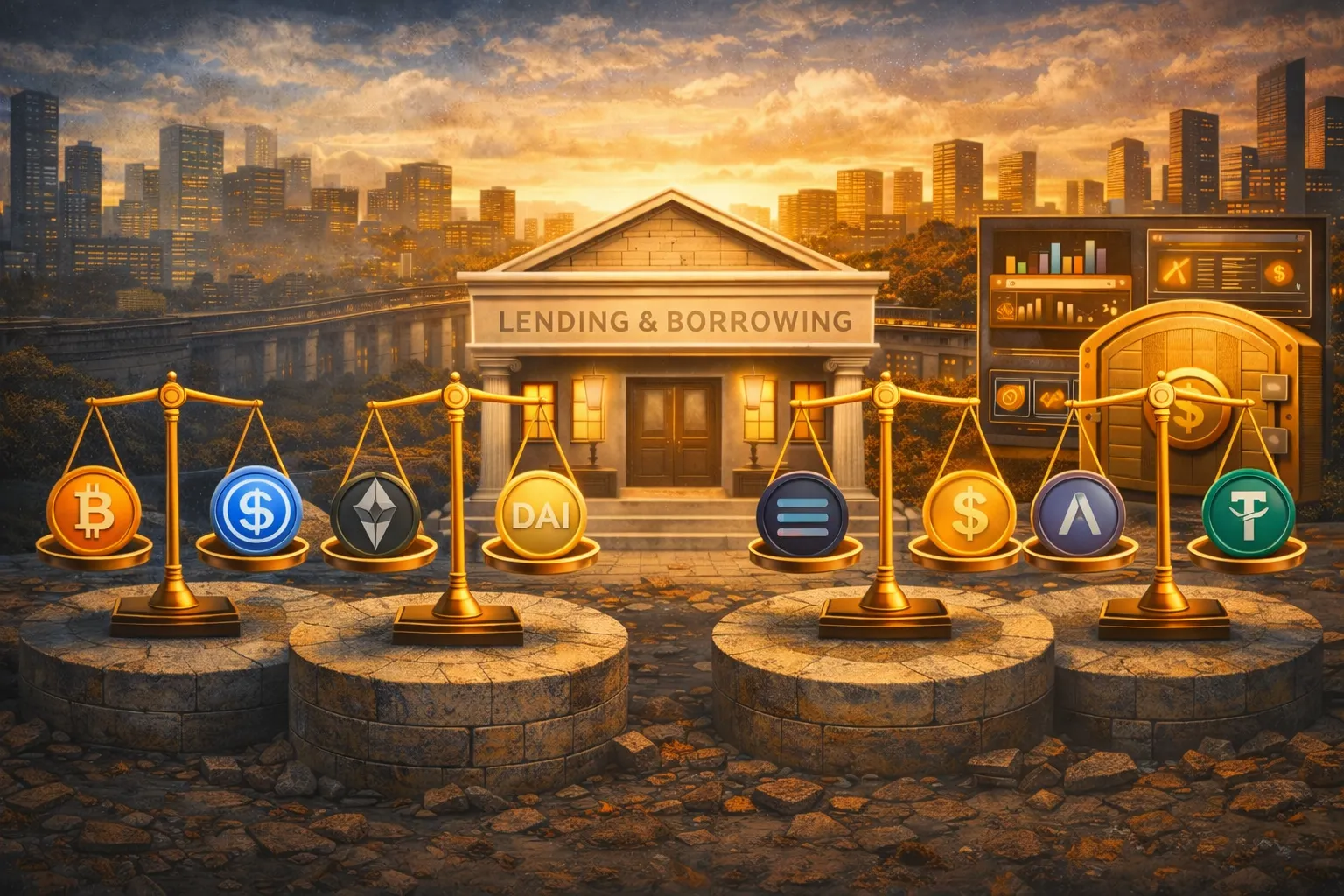 This is where things get interesting. If Ethereum is the financial operating system, then these are the financial applications running on top of it. Applications that can emulate lenders, markets, escrows, and more.
Uniswap (UNI): Decentralized Exchange
Think a giant community pool - two pools actually. One pool holds the first token and the other holds the equivalent monetary amount of a different token. In order to take some of token A, you need to contribute the equivalent amount of token B into the other pool. This exchange upsets the balance, incentivizing bots that make their money on the spread to restore the balance. The pool pays an exchange fee to the individuals lending their assets (market makers), these fees result in profits over time (interest on the money lent to the protocol). It's a good way to earn a little extra on your assets, but just like with bridges, there is a single point of failure - a bug in the protocol could result in the entire pool getting drained (in other words, there is a risk associated with lending your money, even on a decentralized network).
Additionally, if one asset drops in value significantly, the pools will skew to contain more of it, meaning that market makers are being forced to buy a declining asset. This can become a problem if asset's price drops to zero, effectively draining one of the pools to buy a now worthless asset in the first pool.
Curve (CRV): Efficient Swaps for Similar Assets
The concept here is similar to that of a decentralized exchange, but the assets being swapped should have similar or equal value, reducing the risk of one's asset getting devalued significantly. An example here would be two versions of wrapped Bitcoin or two separate stablecoins (a stablecoin is pegged to a real-world currency such as USD).
Aave / Compound: Lending Markets
This is an automated way to lend one's money. Unlike with decentralized exchanges, there is no risk of your funds getting drained because of an imbalance in the token pair pool. But there is still a risk of losing your money with another potential bug - over-leverage. The lender protocol has automatic guardrails for handling over-leveraged borrowers when market conditions shift. However, if market conditions shift too quickly, the protocol may be in the negative even with liquidation.
Conclusion
I'll dive deeper into additional concepts presented here such as "wrapping" and "bridging" in another post, the point here is simply to show how even in its infancy, the cryptocurrency ecosystem already has the building blocks to build an automated version of our existing financial system. As nice as it is to see one's assets grow in value, the real value with crypto is not the hype surrounding it now, but the financial plumbing that we'll only appreciate decades later.
