How My Notebook Became My Admin Panel
 Building a product as a solo developer means wearing every hat. I'm the engineer, the designer, the marketer, the support team. On any given day I'm juggling bugs, features in flight, dependency upgrades, blog posts, user feedback, and rental properties in different markets. To add to the complexity, I'm doing in my free time, while working a W2 and managing my rentals. For a while I could keep it all in my head. Then the number of contexts outgrew my working memory, and things started slipping through the cracks. I needed a better management system that worked in every context: work, business, real estate.
Organization has always been my Achilles heel. Automation has always been my strength. I needed a system that adapts to my workflow, not one that forces me to jump through additional hurdles. So instead of forcing myself to become more organized, I decided to build a self-organizing system that automates away my weaknesses.
Why I Settled on Obsidian
I've tried multiple note-taking systems in the past. Vimwiki has been my go-to for a while, but I can't access it on my phone. Trello was clean and simple, but felt too clunky when I needed to scale: cards were disconnected and it was hard to cross-pollinate ideas between projects. Evernote charged per device and wasn't usable offline. I'd also be at the mercy of them staying in business to access my content. Notion felt unnecessarily complex for what I needed. Desktop-specific apps locked me into one OS, which doesn't work when I'm switching between a Mac at work, Linux at home, and a phone everywhere else. I wanted a simple system I would stick to and could access both from my phone and several other machines I use.
Obsidian felt like vimwiki with a proper UI. It checks every box: compatible with all my devices, extendable via code (my own code, not someone else's plugin marketplace), local storage so my notes stay on my machines, and built on markdown files that will work long after Obsidian the company ceases to exist. The switching cost is zero because the files are just text.
The plugins that extended my workflow was an added bonus:
- Calendar allowed me to link ideas between days.
- Tasks allowed me to build to-do lists I actually track, in the same system I take my notes in.
- Dataview allowed me to add arbitrary JavaScript to my notes and execute it when I load the page.
And that's when a realization hit. If I can embed arbitrary code in my notes, why not integrate my scripts directly into my notebook? The initial proof of concept were my Investomation scripts for checking + fetching data once Census publishes it.
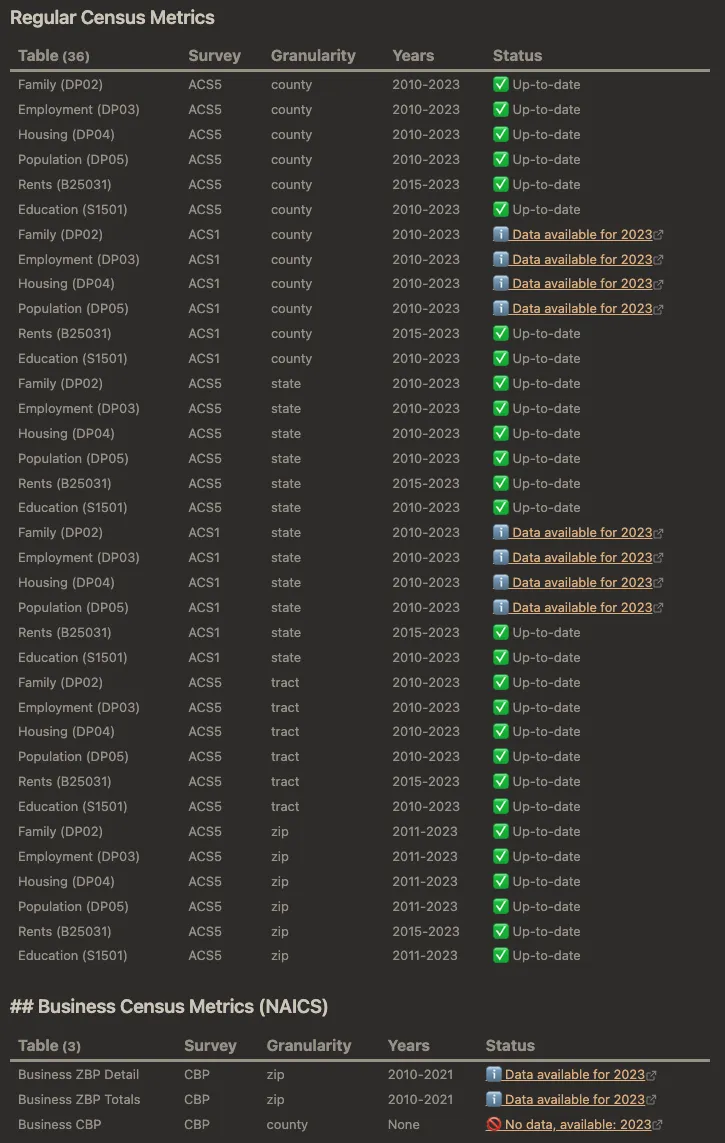 The scripts monitored Census data availability and updated status in real time as new data dropped, downloading it automatically. I had my notebook watching an external resource and automating part of my pipeline.
One Thing Led to Another
Once I'd proven it was possible, I started writing templates for other integrations: tenant communication, rental applications, bug tracking. The templates grew complex enough that I packaged them into an Obsidian plugin. And the plugin kept growing, I got to play with vibe-coding as I built it. It went from templates to API calls to a full orchestration layer sitting on top of my notes: a database, a search engine, a web app that was always on. My documentation became both data and code, depending on context.
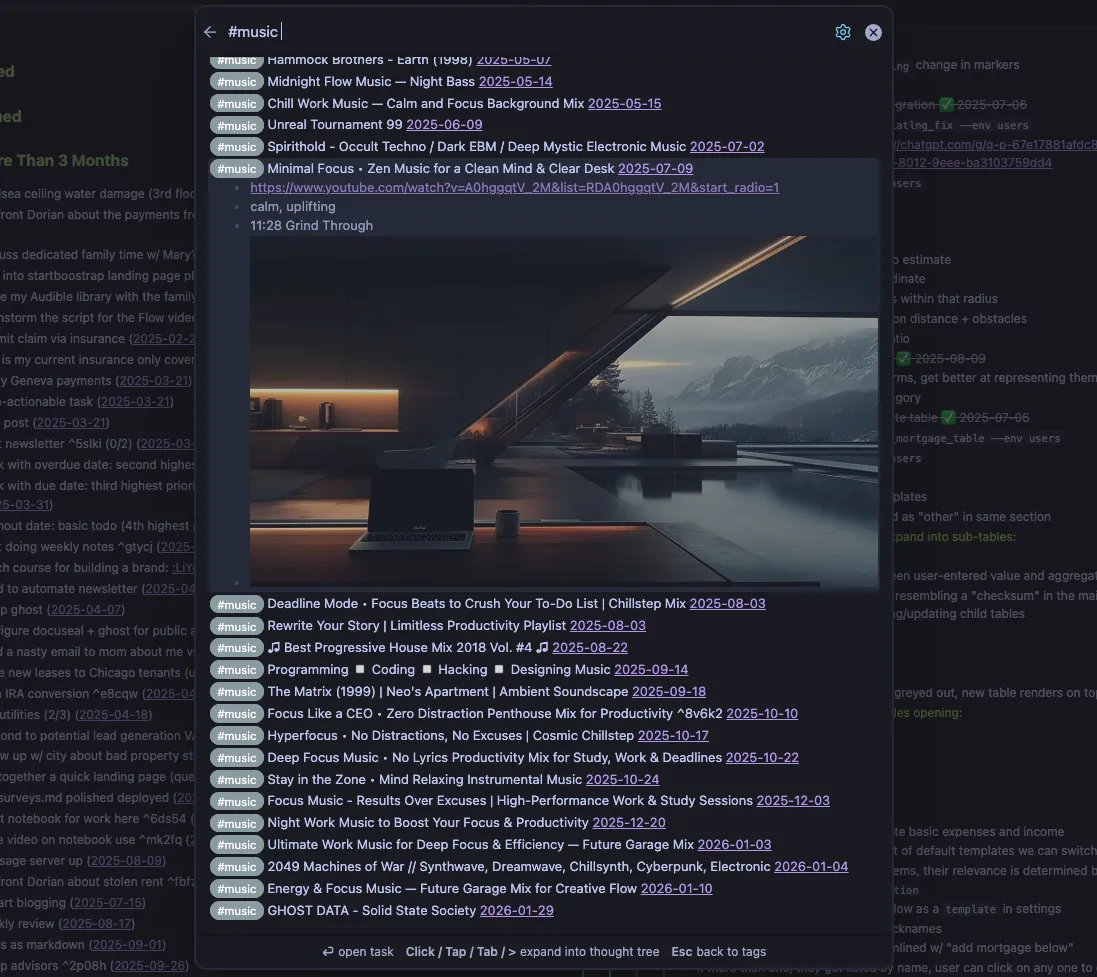 That's a fuzzy search through my music library, running inside my notebook. I'm still building on this system, and I'll dedicate a post to how this evolved once it's further along.
Filing System vs. Search Engine
Most productivity systems fail for the same reason: they require upkeep work upfront. You have to organize things as you create them, put them in the right folder, tag them correctly, maintain the taxonomy. The moment you let that upkeep slip, the system becomes unreliable. If the system is unreliable, you stop trusting it. If you stop trusting it, you stop using it. Every productivity system I'd tried before Obsidian died this way.
I think there are fundamentally two approaches to organization. The first is the filing system: you organize things ahead of time so you know where to find them later. Traditional, tedious, and the default approach of most productivity tools. The second is the search engine: you throw everything into one location (David Allen calls this the inbox basket in Getting Things Done) and build a system that auto-organizes it. I went with the second approach. My daily routine is simple: take notes. Anything I want tracked goes into the notebook. Missing a day is fine. I don't organize my notes when I write them, I tag them. A #blog tag means this idea should become a post. A #todo tag means it's something I need to do. The tags are the only structure I impose, and the system handles everything else. The tags become digital "airtags" for my thoughts.
If you want to follow this experiment along, my repo is here: https://github.com/atsepkov/obsidian-plus.
