Smart Contracts, dApps, and the Birth of DeFi
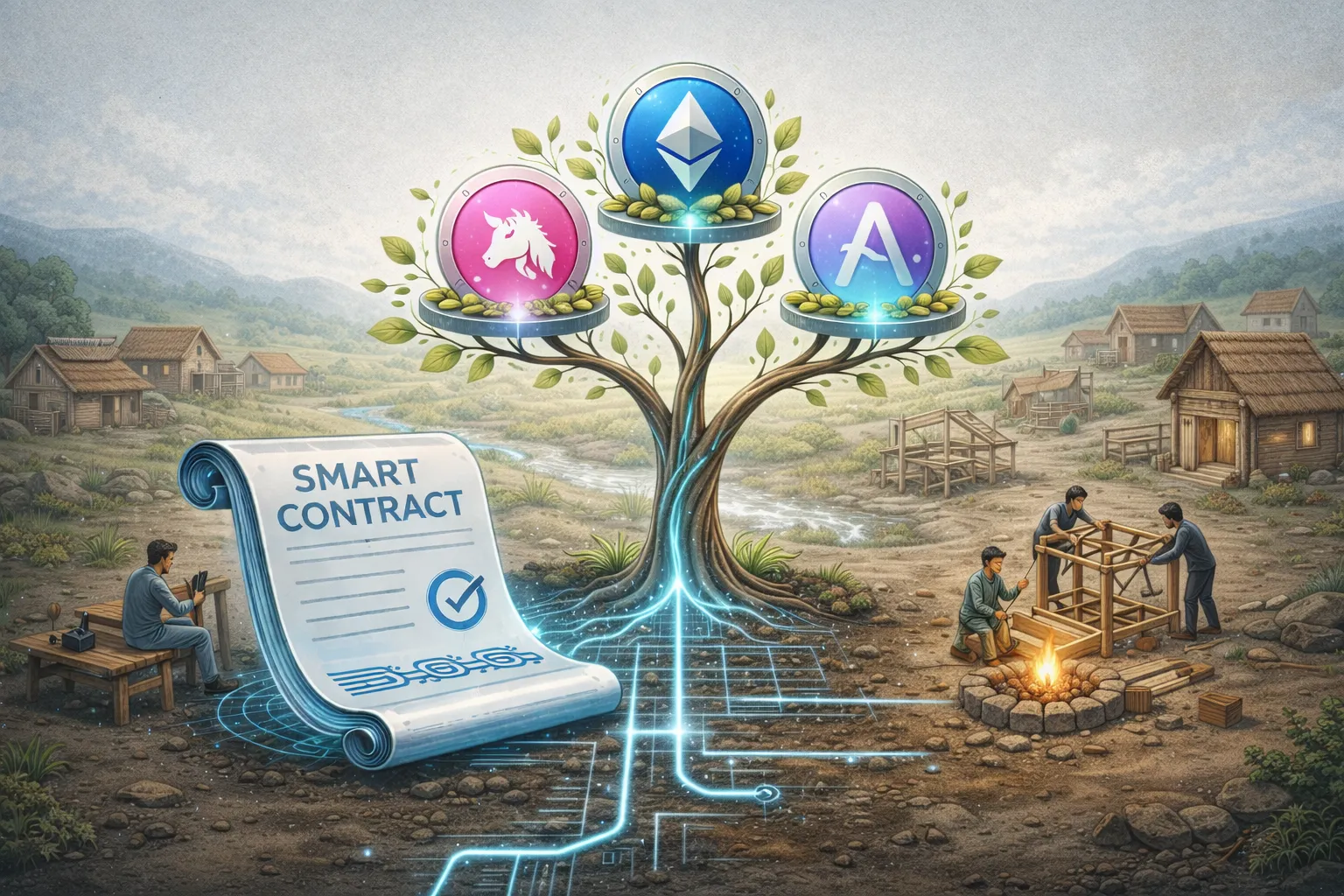 Before smart contracts, before decentralized applications, before DeFi had a name, there was a simpler question. Can money exist without a trusted intermediary? That was the problem Bitcoin set out to solve. Bitcoin’s breakthrough was not speed, programmability, or flexibility. It was finality. For the first time, value could be transferred over the internet without relying on a bank, a payment processor, or a central authority to approve the transaction. No chargebacks. No gatekeepers. Just a ledger that everyone could verify and no one could easily rewrite. Bitcoin proved something profound: trust could be replaced with consensus. But now that money could be moved without middlemen, why stop there?
Ethereum’s Big Idea
Ethereum extended the idea of a blockchain from a ledger of balances to a shared execution environment. Instead of recording only who owned what, it could record what should happen when certain conditions were met. This was the big idea behind a smart contract.
Ethereum did not promise efficiency. It did not promise cheap transactions or instant settlement. Early Ethereum was slow, expensive, and clunky. But it offered something no other system had: a way to deploy code that anyone could interact with, and no one could unilaterally change. It turned the blockchain into a public, permissionless computer. Money was the energy powering this computer, smart contracts were the transistors directing the flow.
What Is a Smart Contract?
A smart contract is a piece of code that lives on a blockchain and executes exactly as written. No human approval. No discretion. No override button. If a traditional contract is enforced by courts and institutions, a smart contract is enforced by the network itself. Once deployed, its rules are fixed.
If funds arrive, release an asset.
If a deadline passes, change the state.
If a condition is satisfied, allow an action.
What makes smart contracts powerful is not complexity, but credibility. Everyone can see the code. Everyone knows the rules in advance. And everyone knows those rules will be applied the same way, regardless of who you are. This was a new primitive for the internet.
From Contracts to Applications
A single smart contract is useful. A network of them is transformative. When developers began composing smart contracts together, something new emerged. Applications that lived entirely on-chain. Not websites backed by servers, but systems defined by code and consensus. These became known as decentralized applications, or dApps.
A dApp is not hosted in the traditional sense. There is no company server deciding whether it is online. The logic lives on the blockchain. Anyone can interact with it. Anyone can inspect it. And no single party can shut it down without shutting down the network itself.
Ethereum turned the blockchain into a giant multiplayer board game. Every player sees the same state, Each block is a turn in the game. When a new block is added, the board advances. Pieces move, balances change, rules are applied. To make a move, players have to spend something. On Ethereum, that cost is paid in ETH. You are paying to take an action on the board. The more complex the move, the more it costs. Smart contracts are the rules of the game.
They define what moves are allowed, what happens when players interact, and how the board evolves from one turn to the next. There are no referees. The rules are enforced automatically at the end of each turn. This was the big idea behind Web3.
Early dApp Experiments
The earliest dApps were simple and clumsy, often inefficient. There were decentralized exchanges that let users trade tokens without an intermediary. Prediction markets that paid out based on real-world events. On-chain games where every move was recorded publicly. Many of these applications would never scale in a traditional environment. Fees were high. User experience was rough. But they proved something important.
You could coordinate strangers with code. You could create systems where incentives aligned without a central referee. You could build mechanisms that behaved the same way whether one user showed up or one million did. Each experiment added confidence. Not that the system was finished. But that it was possible.
The Summer of DeFi
 By 2020, enough of the infrastructure existed for decentralized finance (DeFi) to shift from a dream to reality. Wallets were usable. Tooling improved. Developers had learned from earlier failures. The pieces were finally there to build more ambitious systems. This period became known as the Summer of DeFi.
New protocols launched rapidly. Not with marketing campaigns, but with contracts and documentation. Capital moved faster than anyone expected. Users experimented, lost money, learned, and tried again. It felt chaotic. But it was also creative. Developers were not building companies. They were deploying experiments. Some failed quickly. Others survived stress tests that no startup pitch deck could simulate. For the first time, finance felt open-source.
A Giant, Ongoing Experiment
It is easy to dismiss early DeFi, just like it was easy to dismiss the early internet. On the surface it offers little value over traditional financial systems, just like early email offered little value over traditional mail. But the shift is real, and the world needs it. Modern finance is slow, brittle, and paternalistic. Not because it has to be, but because it grew up around institutions that optimized for control rather than flow.
Sending money across borders takes days, sometimes weeks. Fees are opaque. Settlement is conditional. Transactions can be reversed without explanation. Accounts can be frozen preemptively. Access can be denied based on geography, paperwork, or vague risk models.
These frictions are so normalized that most people stop questioning them. A wire transfer that takes three business days is treated as reasonable. A bank closing at 5pm is accepted as a fact of life. A payment processor holding funds “for review” is shrugged off as the cost of doing business. And yet none of this is technical necessity. It is institutional inertia.
The entities that sit at the center of the financial system have a long history of mismanagement, bailouts, and moral hazard. They regulate monetary access while repeatedly demonstrating that they are not particularly good stewards of risk. The same organizations that collapsed under leverage, mispriced derivatives, and opaque balance sheets now position themselves as guardians against financial recklessness. This is the contradiction decentralized systems are responding to.
Smart contracts and dApps are not an attempt to escape regulation for the sake of chaos. They are an attempt to remove unnecessary discretion from basic monetary interactions. To replace manual approval with deterministic execution. To turn finance into infrastructure rather than negotiation.
When a smart contract executes, it does not care who you are.
When a dApp runs, it does not close for the weekend.
When a transaction settles, it settles globally, not conditionally.
These systems are not perfect. They fail, they get exploited, they break in public. But they also expose assumptions that traditional finance keeps hidden behind procedure and authority. For the first time, people can see what happens when rules are explicit and no one can bend them. No one is too big to fail, no one can force their own failure on the populace through inflation.
