Why Working Hard Won't Make You Rich
 We all have 24 hours in a day. The difference between people who get rich from those hours and people who stay broke from them isn't speed, and it isn't hard work. I used to teach skiing, and the pattern with rookies was always the same: they stared at the snow 2-3 feet in front of their boots because they were scared of what they were about to hit. The result was poor control. Experienced skiers look at the horizon, anticipate the bend in the run, and let their legs handle the micro-details on autopilot. That isn't a skiing skill. It's an abstraction skill, and it's what separates wealth-builders from people who work just as hard but end up with less to show for it.
As we go through life, the challenges and responsibilities we face increase. Kids become adults and have to learn to take care of themselves, chores become full-blown responsibilities that we must manage in order to maintain a healthy and functional lifestyle. Money management also becomes more important as we age, as the consequences of mismanaging our finances become more severe.
One way to deal with increasing demands is to get better at handling them at a faster pace. As Brian Tracy put it, "Don't wish that life would be easier, wish that you would be better". It's not that wealthy people have fewer responsibilities, but that they manage their time better. This is where zooming out and looking at the big picture helps, and that's exactly what abstraction is. Abstraction is learning to see the forest for the trees. By abstracting away lower modes of operation and outsourcing menial tasks, we can free up more energy and time to focus on the work we excel in.
Think of it like a video game. As you progress through the levels, they become harder and require more skill and strategy to overcome. Successful players learn to automate repetitive tasks by assigning keyboard shortcuts, they partner with other players whose skills complement their own to conquer higher level dungeons, and they grind to level up rather than wasting time in the town hall. And if you actually prefer the town hall, why even play the game?
In the same way, successful people in life learn to partner with people who complement their skillset, they pay to outsource tasks and they invest in coaching to accelerate their progress. They understand that their time becomes more valuable as they age, while their money becomes less valuable. They use their resources to accelerate their actions and achieve their goals. Unfortunately, in life it's much easier to get stuck in the town hall than it is in the video game. The progress is not as linear, the goals aren't as clear. Sometimes we go on a sidequest that doesn't move the needle at all. So how do we avoid these sidequests?
Those who're successful are better at juggling more balls at a time, because they focus less on unimportant details, and more on important ones. Sometimes we work on tasks that make no difference in the grand scheme of things at all. Stephen Covey popularized a useful framework for this in 7 Habits of Highly Effective People: the Eisenhower Matrix, which divides any task into one of four quadrants based on urgency and importance:
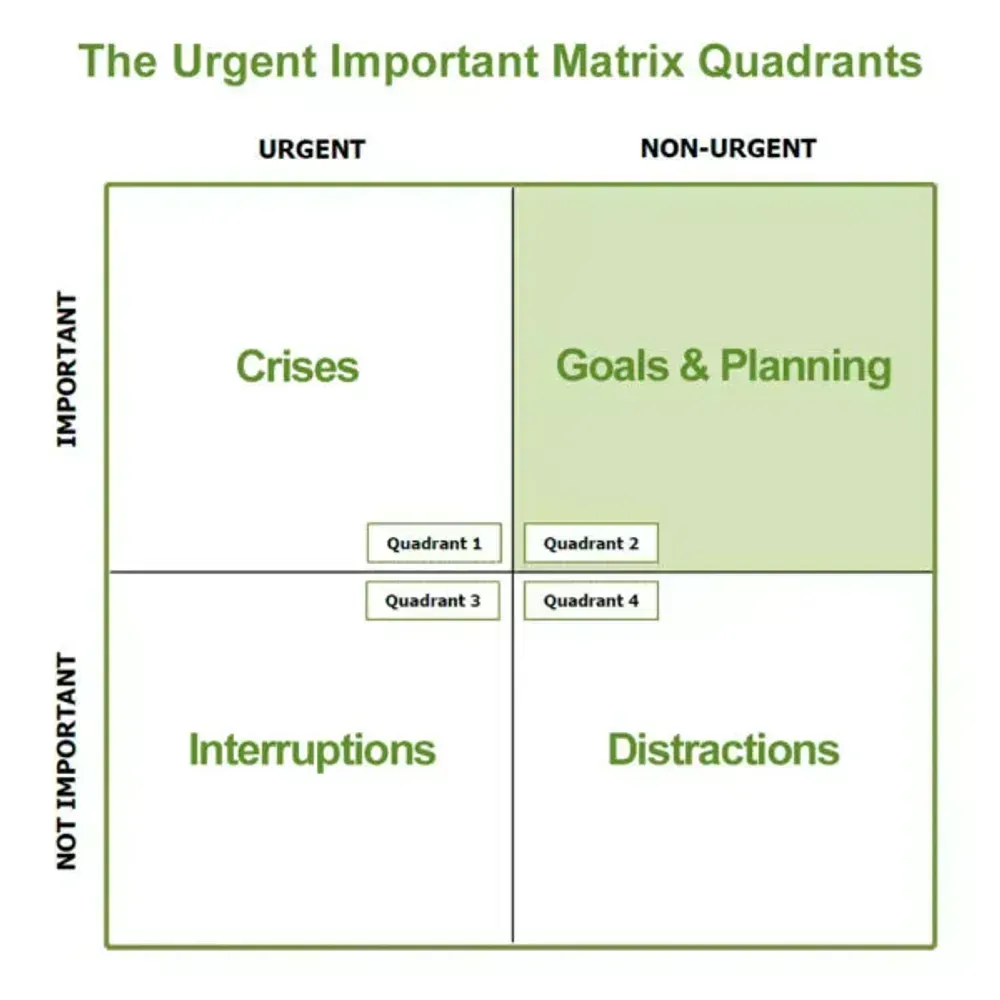
The idea is that tasks in the 1st quadrant tend to expand to fill up all of our available time. The better we get at our job, the less time we need to spend putting out fires because our goals and planning (2nd quadrant) allow us to operate at higher levels of abstraction, we can see the fires ahead of time. The way to level up in the game of life is to get all your crises to a manageable level and then focus on your goals, because it's your goals that help you level up to take on bigger dungeons.
Most people assume 4th quadrant is the worst one to be in (the town hall). They're wrong about that. 4th quadrant is boring, nothing more. If you're the kind of individual who cares about wealth at all (and let's be honest, if you're reading this blog, you probably are), then your mind wouldn't let you stay in the 4th quadrant for long without getting depressed. You know when you're wasting your time.
The problem is the time you're wasting in the 3rd quadrant. These are the crises of others, sidequests that don't move the needle at all. You feel productive at the end of the day, but your personal scorecard will say otherwise (or at least it would, if you spent more time in the 2nd quadrant to put one together).
Ironically these quadrants work the same way with both time and money (two sides of the same coin). The 3rd quadrant is a sinkhole created by people who are so bad at doing tasks in their 1st quadrant that they created a deficit which now sucks you into their crisis as well. It's like a friend who keeps borrowing money from you attempting to win it all back on gambling. Don't let those friends prevent you from reaching your dreams. Cut your ties if you have to. You are the average of the 5 people you spend most of your time around.
This concept of quadrants is yet another abstraction that helps with our productivity. Abstraction is a new way of presenting the problem in a way that simplifies our choices. It's the same dynamic as the ski-instructor story above: the rookie is stuck looking at the next bump (quadrant 1) and never has the attention budget for the bend in the run two turns ahead (quadrant 2). The expert's legs handle the micro-details automatically because the basic mechanics have been internalized, which frees the brain to operate one layer up. That higher level of abstraction is what simplifies the problem.
Every self-made millionaire ran the same cycle over and over to get where they are: prioritize, plan, delegate, figure out what doesn't need to be done at all. They don't work any faster than the people stuck in the third quadrant. They're looking further down the run.
