Concierge Case Study #2: Why We Missed the July Launch (Part 2)
Series: Concierge Case Study #2 (Charlotte STR)
- Part 1: Closing on New Construction
- Part 2: Why We Missed the July Launch (you are here)
- Part 3: Furnishing a 15-Guest AirBnB
- Part 4: Launch Numbers (coming soon)
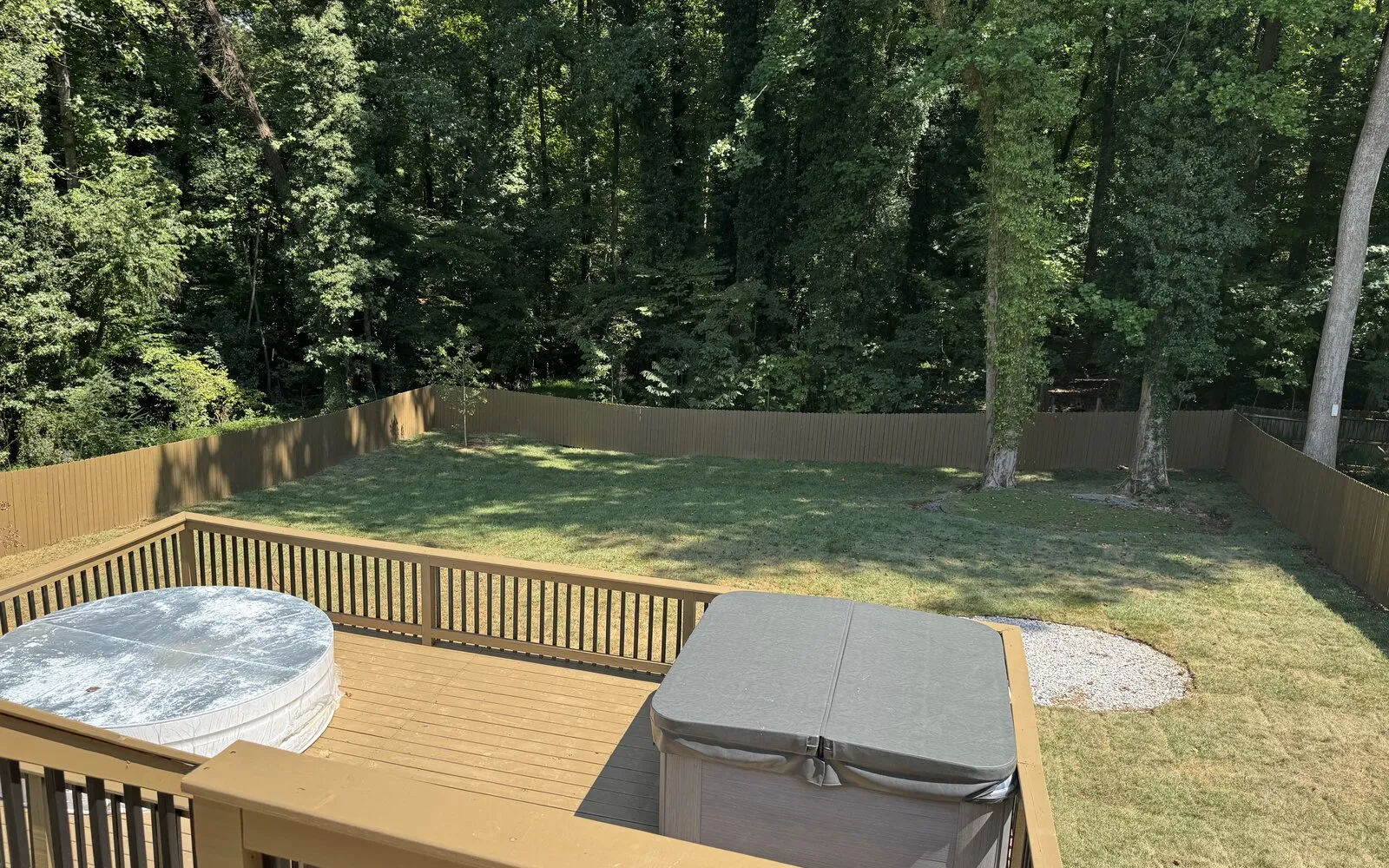 In Part 1 I wrote that the listing target had moved to mid-July. It's mid-September and the house still isn't listed. Our team did good work, and most of the house is done: paint, wallpaper, furniture, art, TVs, and bathrooms. What it doesn't have yet is mattresses, sheets, or anything in the kitchen drawers, because the last two tabs of the shopping list were put on hold in May and never taken off hold.
Our team in Charlotte handled the design, the contractors, and the installation, and I did the ordering. Almost nothing that went wrong had to do with the design or the build. It came down to ordering an entire house online from out of state, one link at a time.
The house on September 4th
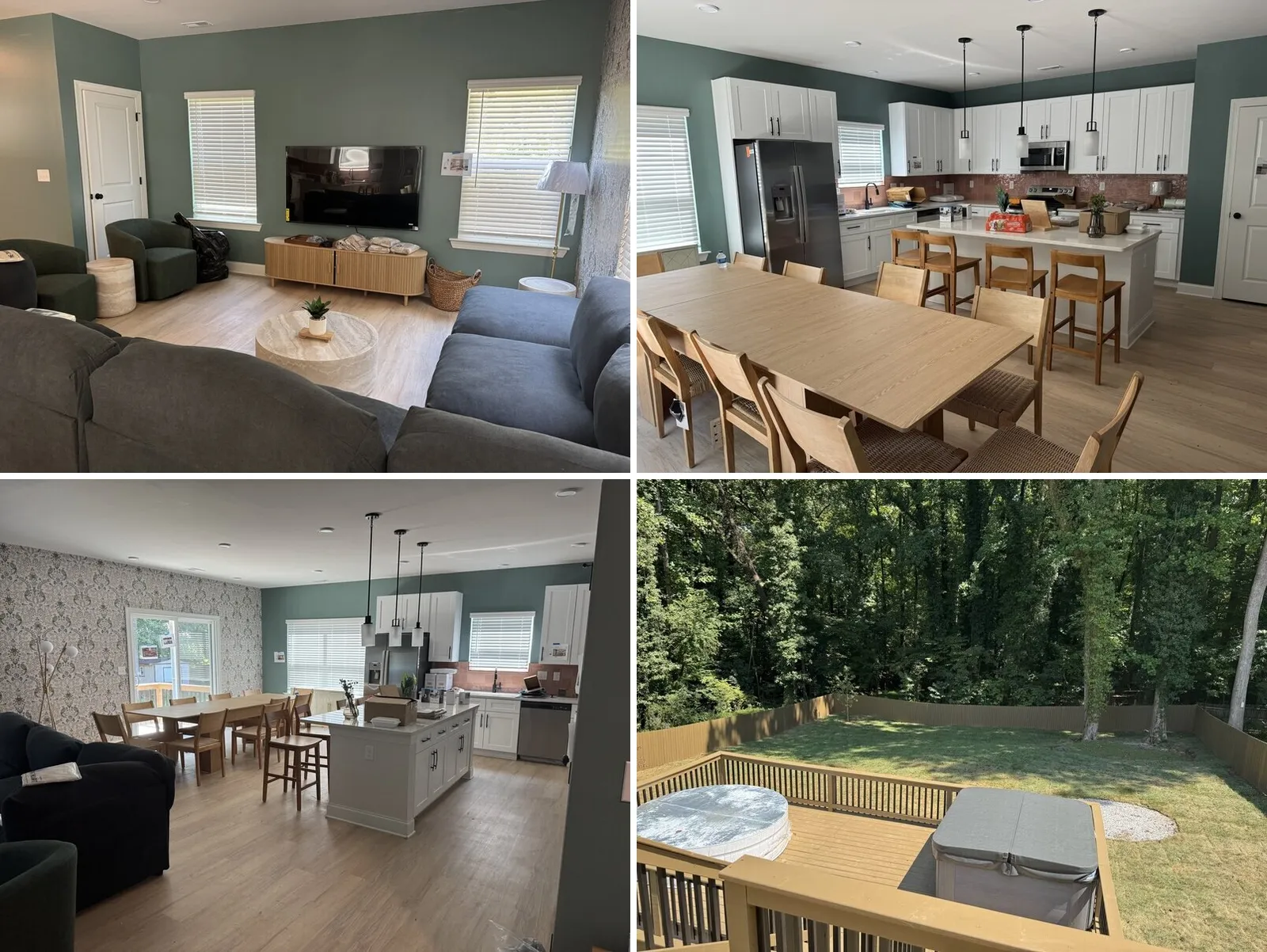
I walked through the house on September 4th. I fly out regularly to inspect my properties, because a lot of problems don't show up in progress photos. Most of the house was done. The garage game room was finished, from the slatted accent wall to the dartboard. The living room had its sectional, swivel chairs, and mounted TV, the dining table and island stools were in, and the wallpaper was up in the living room, foyer, and powder room. The bathrooms had their accessories and shower curtains, and the washer and dryer were in. Out back, both levels of the deck were built, with the hot tub and pool in place and new sod coming in, but no deck furniture yet. Downstairs, what was left was mostly unpacking.
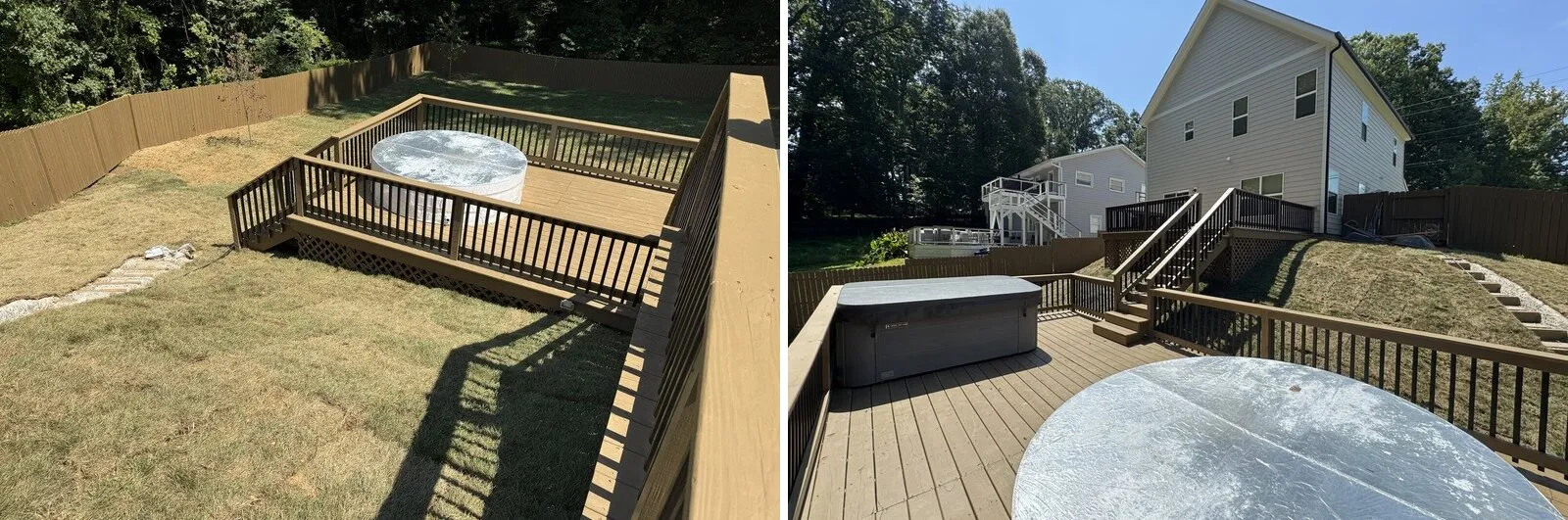 The deck on September 4th: the lower level from the upper deck, with the pool still covered (left), and looking back up at the house from the hot tub deck (right).
Upstairs, every bedroom had its wallpaper, curtains, dresser, TV, and art, and every bed was bare slats. One accent wall was a panel short of wallpaper.
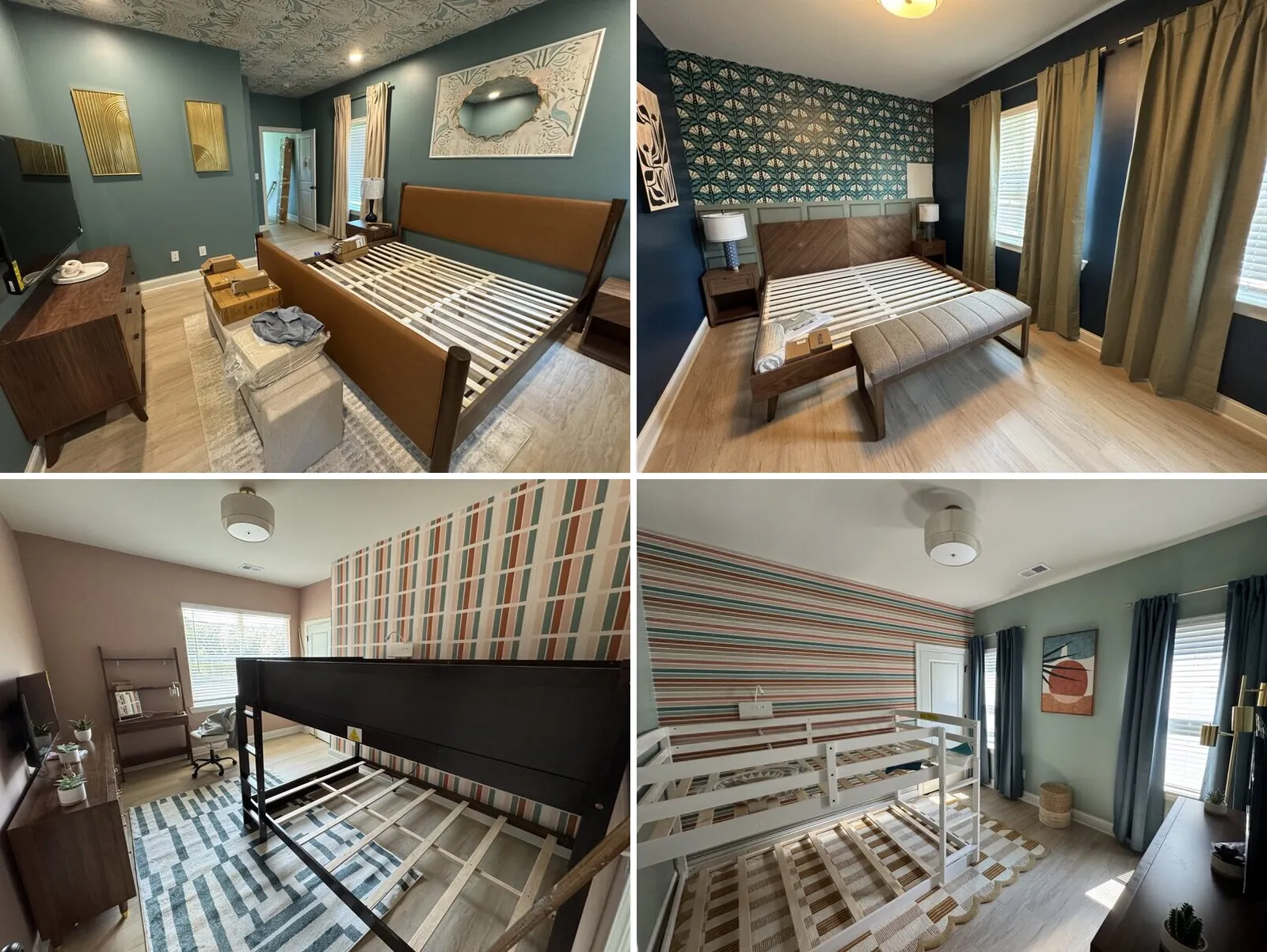
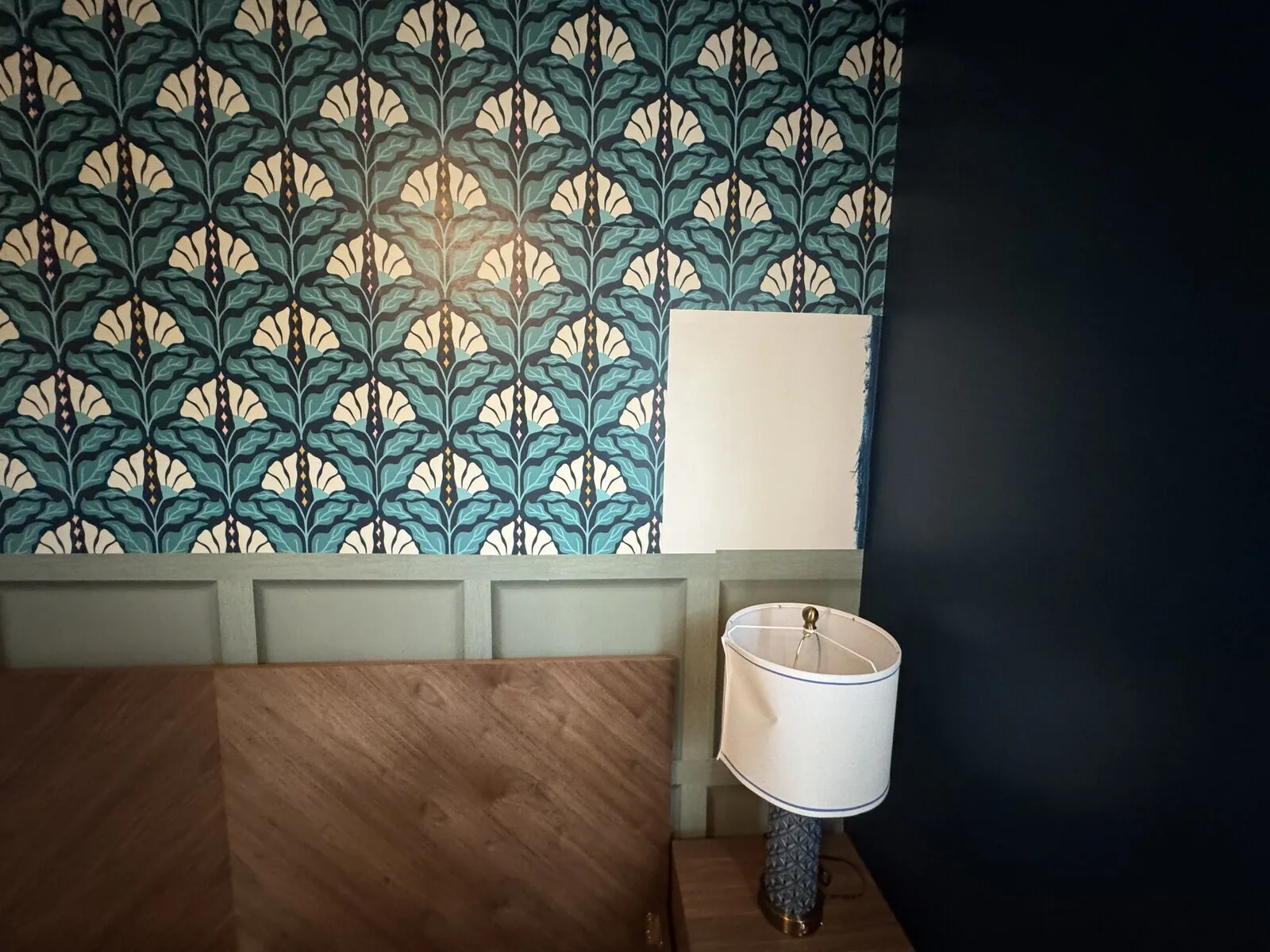 Without mattresses we couldn't book the photographer, and without photos we couldn't list.
The budget moved before anything was bought
Because the design work had started before closing, by late April we had room designs and the backyard render from the top of Part 1, and on May 1st the contractor's quote came in. The deck in the render looked great. I also told the team that $70k was a hard limit for the whole project, and the deck alone was going to eat a big piece of that.
The team's first pass cut $6,100 by shrinking the deck. The lot drops away from the back of the house, so the revised design kept two levels to work with the slope: an 18-by-15-foot upper deck off the back door for dining and the grill, and a 25-by-13-foot lower deck for a hot tub and a cowboy pool, a galvanized stock tank that doubles as a cold plunge.
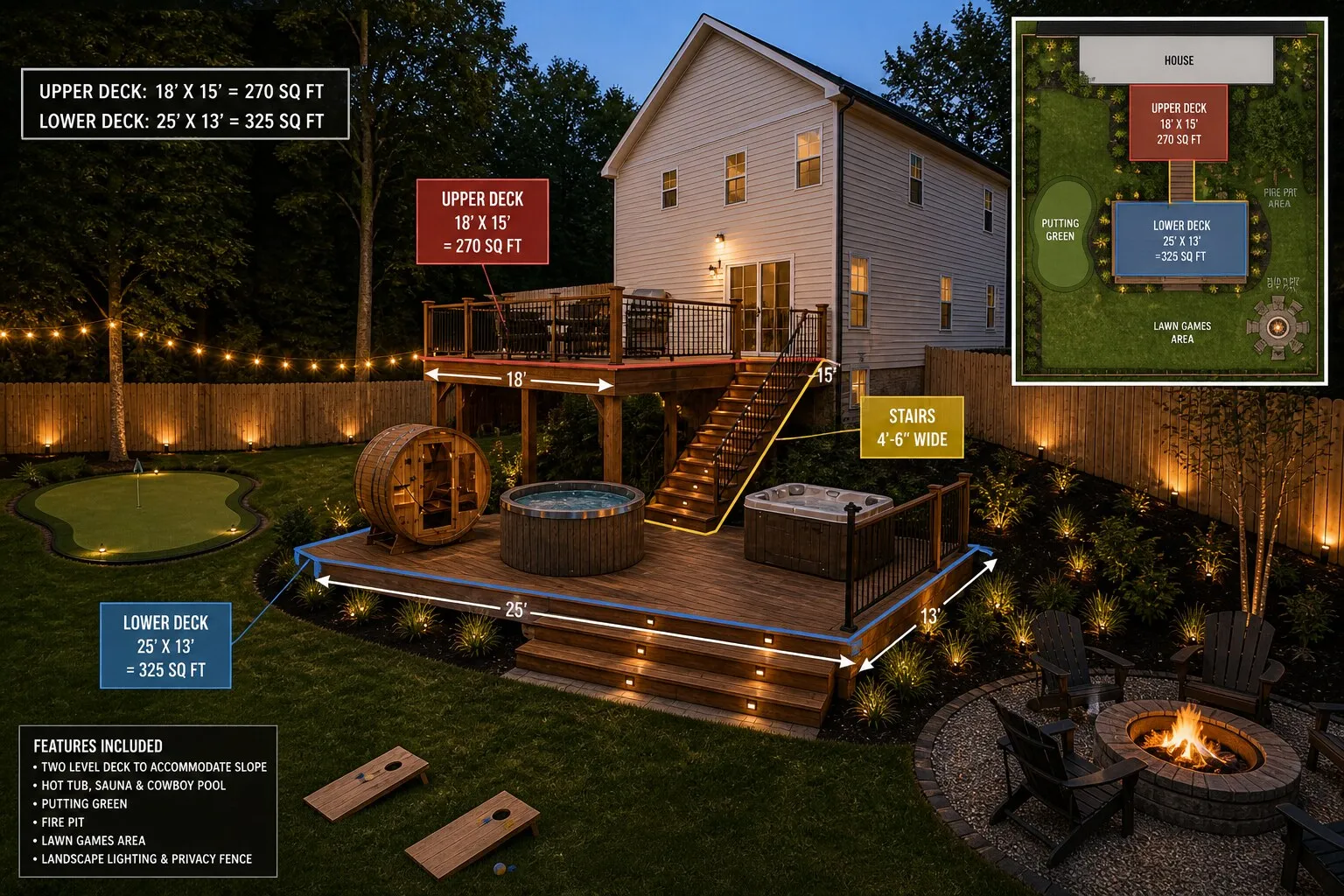 The revised deck design from May 5th. Part 3 shows what we built.
That still left the total around $90k. Getting all the way to $70k meant dropping the sod and the putting green. Our team pushed back that without sod the backyard would be "pretty bare bones and dry, there is no grass there," so we kept both and settled on May 28th at about $85k.
I set the budget after I'd seen the design, which was backwards. A design shows you what's possible, and once you've seen it, every cut feels like a loss. If the $70k number had gone to the designer before the first sketch, it would have shaped the plan from the start.
The deposit invoice for materials and labor didn't come through for two weeks because of a banking problem on our side, so the money landed on May 26th, almost four weeks after the quote. Material ordering started the next day.
I ordered on my own card
On this house I did the ordering. The designer built a spreadsheet with a tab per room and a link for every item, I ordered on my own card and shipped everything to the house, and the crew brought it in, assembled it, and installed it.
The list arrived on May 28th with one instruction attached: ignore the highlighted section of the "essentials" tab and the outdoor tab, because those were being reworked for the smaller backyard design.
I started ordering on the evening of May 30th, room by room as suggested, Wayfair first because its delivery dates are whatever Wayfair sets. The problems started that night:
- Purchase limits. The curtain rods on the list were limited to one per customer, and we needed four or more that matched.
- Out of stock. Several items were unavailable, so I substituted. I was ordering from a list of links, not from the design, so a substitute that looked right to me didn't always look right in the room. One chair arrived in the wrong color. One link turned out to point at the wrong fabric altogether.
- Shipping costs. Three round stone coffee tables cost more to ship than to buy.
- Card holds. To a retailer, a new shipping address and a pile of large orders on one card in one evening look like fraud. Before the night was over, Amazon put my account on hold for suspicious activity and cancelled the orders in progress, and the rep on the phone said it would take three to five days to lift.
The hold cleared and I kept going through June, with a few more orders failing along the way ("Unexpected problem with completing your order"), which I re-placed. Other orders were cancelled after checkout without any notice. By the end of June I'd worked through everything on the list that wasn't marked to hold off. The pool arrived in July. The original target for listing was mid-July, and the contractors were wrapping up their phases in August.
The "hold off" that never got lifted
The biggest miscommunication was the hold. We were told in May to hold off on the last two tabs while the backyard was redesigned, and the go-ahead to order them never came. When I went back through the list in July, those tabs still said to hold off, and I assumed someone would tell me when that changed. Either of us could have asked. A due date on the hold, or a check-in once the backyard plan was settled, would have caught it months earlier. It was my card and my list, so I should have followed up sooner.
It surfaced at the end of August. The new sod went in, my team did a walkthrough, and most of the outdoor furniture wasn't there. On September 4th they went through the list room by room and found items marked as ordered that weren't in the house, and then the bigger gap: the entire essentials tab and the backyard tab had never been ordered. That included every mattress, every sheet and towel, and every kitchen item.
Part of the confusion was the order history. Amazon lists orders by date, but the delivery or cancellation status only shows when you open each order. With dozens of orders, some of them cancelled during the June card problems and re-placed, there's no easy way to see what arrived. By September, some of those orders were more than 60 days old, which is past the point where Amazon will do anything about an item that never showed up.
The list, the orders, the deliveries, and the crew's view of the house lived in different places: a spreadsheet, two retailer accounts, a text thread, and whatever the crew saw on site. I've been building a notebook-based task system for my AI work that could handle this. Each property gets its own notebook. The shopping list goes in, every item becomes an order task with a status, and everyone involved sees the same documents, invoices, tracking numbers, and dates. When something is ordered, the crew gets the delivery date. When it arrives, the doorbell camera or the crew's next site visit marks it delivered, and an agent matches the package to the order. A hold with no date would have shown up as a stale task in June. Logistics companies have tracked shipments this way for years, and we're building the same thing into the dashboard our Concierge clients use, so the owner and the crew see each item's status next to the expense line items and receipts.
The card holds came back in September
On September 10th I started ordering the missing tabs, and the cancellations started again. Spacing the batches 24 hours apart didn't help. For the next few days I went back and forth with Amazon and my bank. The bank explained that a card purchase passes two separate fraud checks, the bank's own and Visa's. The bank's declines come with a text asking me to confirm, and one came around that time, so I knew what a normal decline looked like. Visa had recently tightened its system, and the bank said several other customers were having the same problem, specifically with Amazon, because Amazon hadn't fully integrated with the change. When Visa flagged an order, nothing reached my phone, and Amazon quietly cancelled it. The block came off on Monday the 14th, and the orders finally went through.
This is the main reason our team is moving away from having owners do the ordering. Orders for another owner on a personal card ran into cancellations, while orders placed through our business account for a different owner had none.
Meanwhile the meter from Part 1 keeps running. Carrying costs have been about $3,000 a month since April, and the two months of rental income I planned on starting in mid-July haven't happened.
Doing it yourself caps how many houses you can own
Our team has set up several houses before this one, and every run makes the next one smoother. When it's our own house, the rough edges hit us instead of a client. This one surfaced the ordering problems above, and the fixes are already in place: our team orders on its business account, and the tracker is going into the Concierge dashboard. That's the system that handles these headaches for Jane. Go back to Bob and Jane, who bought the same house on the same day, and picture them five years later.
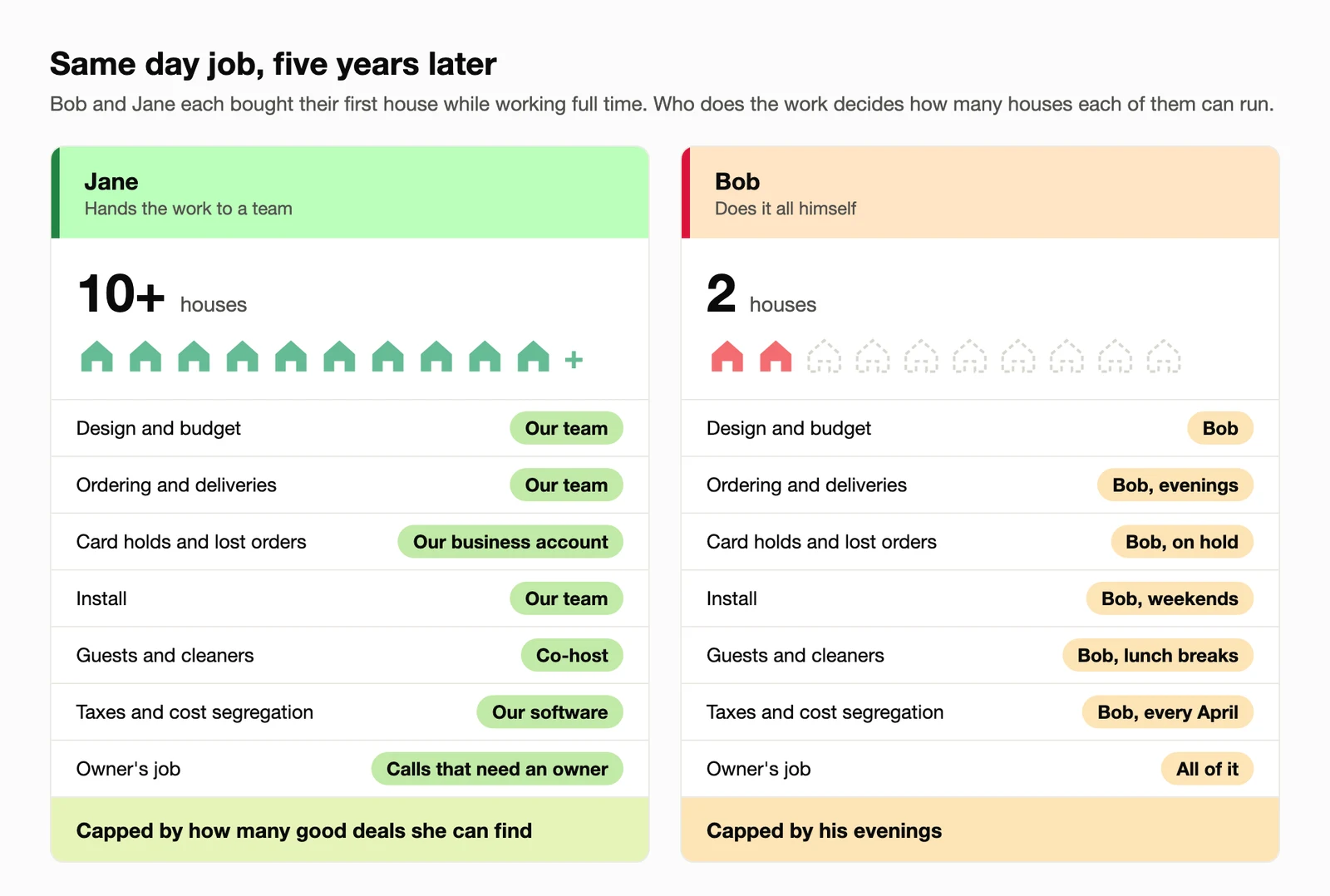
Everything in the lessons below is yours to copy. Just don't expect your first house to go as fast as our next one.
Lessons from the ordering phase
- Set the budget before the design. Hand the designer the number along with the brief.
- Let whoever installs do the ordering. Our team now orders on a business account and invoices the owner, which avoids most of the fraud-filter problems. If the owner has to order, tell the card issuer before the first big night, spread the orders out, and check every order's status a day later instead of trusting the checkout page.
- Budget three to four weeks for ordering problems. Account holds, declined cards, out-of-stock items, and re-orders each cost days, and they compound.
- Track every item to "installed," with one owner. Ordered, delivered, and installed are three different states. Retailer order histories won't show you the difference at a glance, and a cancelled order can look like a placed one, so the tracker has to.
- Every "hold off" needs a date and a name. Write both on the list next to the item and put the date on a calendar.
- Walk the house against the list every couple of weeks. If you're remote, fly out or have the crew send a video walkthrough. Either one would have caught it in June.
- Get the design intent, not just the links. Links go out of stock and point at the wrong thing. If the owner is substituting, they need to know what each room is supposed to look like.
This house also gave us a baseline for how long each stage takes and where the time went. Almost four weeks passed between the contractor's quote and the deposit, ordering problems ate most of June and another week in September, and the hold sat for three months. The changes above cut most of that, and the tracker timestamps each stage so we can measure the next launch against this one. Next we want to order the essentials (mattresses, linens, kitchen) as a standard kit at closing, since they don't depend on the design.
As of this week, the outdoor furniture is arriving, most of the essentials are ordered, and the new target is to be listed by the end of September. A muralist also just finished a mural on the big blank garage wall, which I'll save for Part 3, along with the finished rooms.
Our team now handles the ordering for Investomation Concierge clients, along with the design, the install, and co-hosting. Concierge is included with our Business membership.
