Fundamentals of Investing: A 9-Lens Framework
 Here's a riddle: You have $60,000 to invest. Stocks are returning 10% annually. Real estate in your area appreciates at just 3% per year. Which is the better investment?
If you picked stocks, you're not seeing the full picture. With real estate, that $60,000 becomes a 20% down payment on a $300,000 property. A 3% appreciation on $300,000 is $9,000, a 15% return on your actual cash. And we haven't even mentioned the rental income, the tax benefits from depreciation, or the inflation protection.
Single metrics are seductive. They make comparisons clean and decisions easy. But they hide everything that actually matters. Comparing investments requires a framework that captures all the forces working for or against you.
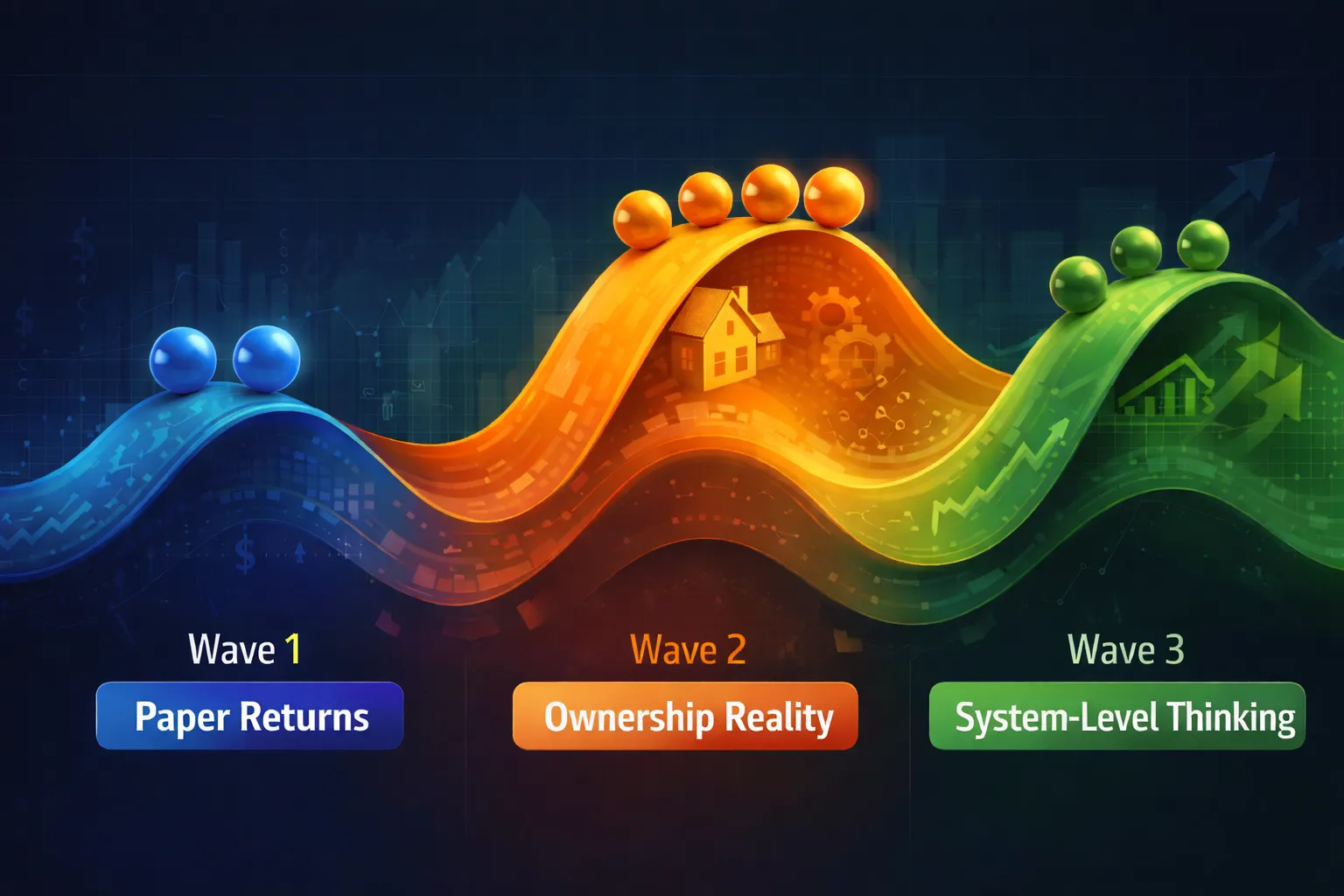
I've refined this into what I call the 9-Lens Framework, organized into three waves of understanding. Wave 1 covers what investments promise: the returns you see on paper. Wave 2 reveals what it actually feels like to own them, including the hidden costs and friction. Wave 3 is where sophisticated investors operate, understanding the system-level forces that amplify or erode your wealth.
Wave 1: Paper Returns
These are the numbers you see in headlines: the returns investments promise on paper.
Lens 1: Appreciation
What's the potential for capital gains? This is where stocks and crypto shine. A diversified stock portfolio historically returns 7-10% annually, with individual stocks capable of 10x or 100x returns if you pick winners. Crypto is even more volatile, with the potential for massive gains (or losses) over short periods. Real estate appreciates more slowly, typically 3-5% annually on average, though this varies dramatically by location. Gold has modest appreciation in dollar terms. It's risen from $35 to nearly $2,000 since 1971, but much of that reflects the dollar losing purchasing power rather than gold gaining intrinsic value. It's primarily a store of value, not a growth asset.
Lens 2: Yield
Does this asset generate passive income while you hold it? Real estate is king here. Rental properties can generate 6-12% cash-on-cash returns annually while you still own the underlying asset. Dividend stocks typically yield 2-4%. Bonds pay fixed interest, usually 3-6% depending on risk. Crypto and gold generate no yield by default, though emerging DeFi protocols are beginning to offer ways to earn interest on crypto holdings (with additional risk).
Wave 2: Ownership Reality
What it actually feels like to hold these investments: the friction, costs, and time.
Lens 3: Liquidity
How quickly can you convert this asset to cash? Stocks are highly liquid; you can sell in seconds during market hours. Crypto trades 24/7 and is also highly liquid for major coins. Bonds are moderately liquid depending on the bond type. Real estate is the least liquid; selling a property takes months and involves significant transaction costs (typically 6-10%) between commissions, closing costs, and repairs. Gold falls somewhere in the middle: you can sell quickly, but physical gold requires finding a buyer and verifying authenticity. Gold certificates are quicker to sell (in a good market) but may not actually be worth the gold they claim to be backed by (in a bad market).
Lens 4: Operating Costs
What does it cost to maintain this investment? Stocks have minimal operating costs: just brokerage fees and fund expense ratios. Bonds are similar. Crypto requires secure storage (hardware wallets, etc.) but otherwise has low costs. Real estate has significant operating costs: property taxes, insurance, maintenance, property management, vacancies, and repairs. These can easily consume 40-50% of gross rental income. Gold presents a trade-off: physical gold requires storage and insurance costs, while paper gold (ETFs, allocated accounts) introduces counterparty risk: you're trusting a third party actually holds your gold.
Lens 5: Complexity & Time
How much of your life does this investment consume? Index funds are "set and forget": buy once, check occasionally. Individual stocks require research and monitoring. Bonds are similarly passive. Gold just sits there. Crypto demands attention: following protocol changes, managing wallets, navigating exchanges. Real estate is the most time-intensive by far. Being a landlord means tenant screening, lease negotiations, maintenance calls at 2 AM, and navigating local regulations. Even with property management, you're still making decisions and dealing with issues. This is the hidden cost that doesn't show up in any return calculation.
Lens 6: Volatility
How much does the price swing? This lens matters enormously because it determines what holding actually feels like, and whether leverage is even possible. Bonds are the most stable, with modest price movements. Real estate values change slowly and you don't see daily quotes (a psychological advantage). Stocks have moderate volatility; the S&P 500 has experienced 50%+ drawdowns but recovers over time. Gold is surprisingly stable for a "hard asset." Crypto is in a league of its own. Bitcoin has seen multiple 50-80% crashes, sometimes within weeks. This isn't just about stomach tolerance; high volatility makes leverage suicidal. A 50% drawdown on a 2x leveraged position wipes you out completely, no matter how good the long-term returns look on paper.
Wave 3: System-Level Thinking
What sophisticated investors understand: the structural forces that amplify or erode wealth over time.
Lens 7: Inflation Protection
Does this asset preserve purchasing power when the dollar loses value? Hard assets like real estate and gold tend to rise with inflation because they're priced in dollars but have intrinsic utility. Stocks offer moderate protection since companies can raise prices with inflation. Bonds are the worst inflation hedge because they pay fixed returns in nominal dollars, meaning inflation erodes their real value over time. Crypto is still being tested, but Bitcoin's fixed supply gives it theoretical inflation protection similar to gold.
Lens 8: Tax Treatment
How does the government treat your gains? This lens separates sophisticated investors from beginners. Stocks held over a year get favorable long-term capital gains rates (0-20%), but you pay taxes when you sell. Real estate offers the most tax advantages: depreciation lets you deduct paper losses against rental income, 1031 exchanges let you defer gains indefinitely, and the stepped-up basis at death can eliminate capital gains entirely. Bonds pay interest taxed as ordinary income (the worst treatment). Crypto is taxed like stocks: capital gains when you sell. Gold is taxed at the collectibles rate (28%), which is worse than standard long-term gains. Tax treatment can easily add 2-3% to your effective annual return if you play it right.
Lens 9: Leverage
Can you use other people's money to amplify your returns? Real estate wins decisively. Banks will lend you 80% of a property's value at relatively low interest rates because the property itself serves as collateral. A 20% down payment controls 100% of the asset. Try getting a bank to lend you money to buy stocks, and they'll laugh you out of the office. Margin accounts exist but come with high interest rates and margin calls. Crypto leverage is available through exchanges but is extremely risky. Gold and bonds offer essentially no leverage opportunity for individual investors.
Putting It All Together
Here's how the major asset classes compare across all nine lenses:
| Lens | Stocks | Bonds | Real Estate | Crypto | Gold |
|---|---|---|---|---|---|
| Wave 1 | |||||
| Appreciation | High | Low | Medium | Very High | Low-Med |
| Yield | Low-Med | Medium | High | Low* | None |
| Wave 2 | |||||
| Liquidity | High | Medium | Poor | Very High | Medium |
| Operating Costs | Very Low | Very Low | High | Low | Low** |
| Complexity | Low | Low | High | Medium | Low** |
| Volatility | Medium | Low | Low | Very High | Low |
| Wave 3 | |||||
| Inflation | Medium | Poor | Strong | Untested | Strong |
| Tax Treatment | Good | Poor | Excellent | Good | Poor |
| Leverage | Low | None | Very High | Medium*** | None |
* Emerging DeFi protocols offer yield with additional risk
*** Paper gold (ETFs) adds counterparty risk.
*** High volatility makes crypto leverage extremely dangerous.
Wave 1 lenses are obvious to everyone, even outsiders. Spectators often see asset classes they don't understand through the first two lenses, ignoring the rest. Your tenant who thinks you're making a killing sees the appreciation and the rent checks, but not the 2 AM maintenance calls, the three-month vacancy, or the $15,000 roof replacement. Your coworker who says "you should've bought Bitcoin in 2015" sees the 100x return, but not the exchange hacks, the lost wallet keys, or buying when everyone else called it a scam.
Actual investors learn Wave 2 the hard way. They discover that the 8% cash-on-cash return comes with midnight phone calls and months of vacancy. They realize their "liquid" crypto requires navigating exchange outages and wallet security. Education is expensive, especially when you're learning from your own mistakes.
Those who survived Wave 2's friction reap the benefits of Wave 3. Wave 3 is the scaling phase, when investors go from storming to performing. Real estate's tax advantages add 2-3% to your effective annual return. Leverage at 4% interest against an asset appreciating at 5% creates wealth from thin air. Inflation slowly transfers purchasing power from bondholders to asset owners. These aren't tricks. They're the rules of the game, visible only to players who stuck around long enough to learn them.
Each lens is a spectrum. Appreciation ranges from gold's modest gains to crypto's 100x potential. Same is true of risk and volatility, but in reverse. 99% of cryptocurrencies will go to zero - same is true of many startups. Yield spans from growth stocks paying nothing to stabilized multifamily generating 10%+ cash-on-cash. Liquidity stretches from stocks you can sell in seconds to real estate that takes months. Complexity runs from index funds you set and forget to rental properties demanding constant attention. Every investment sits somewhere on each of these nine spectrums. The question is whether the position fits your strategy.
Within each asset class, there are additional strategies (e.g. BRRR, mid-term rentals, turnkey investing) and sub-categories (e.g. self-storage) that have their own unique distribution along the same 9 dimensions. AirBnB brings higher yield than long-term rentals at the expense of complexity and operating costs. Mid-term rentals fall somewhere in-between. I'll try to break down individual strategies within each class into the same framework in future posts.
