Single-Family vs Multi-Family Investing
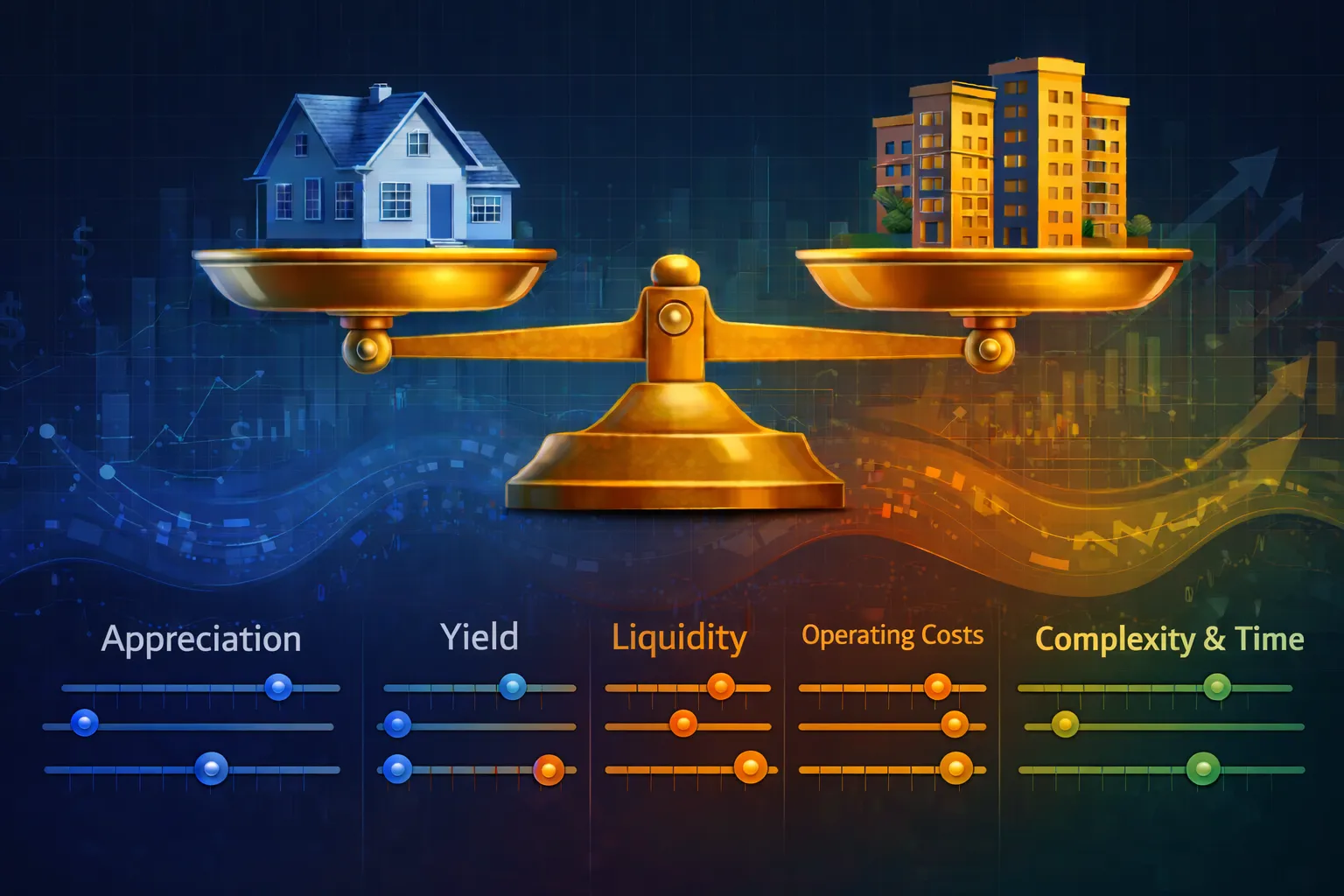 When investors say "multifamily," they usually mean one of two things. Small multifamily (2-4 units) is financed with residential loans, same as single-family homes. Large multifamily (5+ units) requires commercial financing with different underwriting standards. This distinction matters enormously because the financing changes everything about how the investment works.
Single-Family: The Beginner-Friendly Option
Single-family homes are how most investors start, and for good reason. The financing is straightforward: conventional 30-year fixed mortgages at the best rates. The tenant pool is large because many families prefer houses over apartments. The exit strategy is flexible since you can sell to owner-occupants who typically pay more than investors.
The operational simplicity is underrated. One tenant, one lease, one set of utilities, one property to maintain. When something breaks, there's no ambiguity about who's responsible. When you need to renovate, you do one project at a time. The learning curve is manageable.
The downside is scaling. Each single-family home is a separate transaction with its own closing costs, inspections, and financing. Building a portfolio of 20 single-family homes means doing 20 deals. You can only have 10 conventional mortgages in your name before lenders cut you off. Management becomes geographically scattered if your properties aren't clustered.
Small Multifamily (2-4 Units): The Best of Both Worlds
Duplexes, triplexes, and fourplexes are my favorite asset class for building wealth. You get residential financing (30-year fixed, low rates, low down payment if owner-occupying) while acquiring multiple units per transaction.
A fourplex generates four rental incomes with one closing, one insurance policy, one roof, one lawn to maintain. The efficiency is significant. If one unit goes vacant, three are still paying rent, smoothing your cash flow. You can house-hack by living in one unit and renting the others, qualifying for owner-occupant financing while building your portfolio.
The tenant pool shifts toward renters-by-necessity rather than renters-by-choice, which means more turnover and potentially more management intensity. Finding good small multifamily deals is competitive because sophisticated investors know they're valuable. Many are owned by long-term holders who rarely sell.
Large Multifamily (5+ Units): Different Rules Apply
Once you cross the threshold into commercial financing, the game changes. Banks evaluate the property based on its income, not your personal financials. This is liberating for experienced investors since you can scale without running into personal debt limits. But the financing terms are harsher: shorter amortizations (often 20-25 years), balloon payments requiring refinancing, adjustable rates, and higher down payments (25-30%). If you've read my post on 5 irrational things lenders do, you know that DSCR loans can help bridge some of these gaps.
Large multifamily is valued differently too. Single-family homes and small multifamily are valued by comparable sales: what did similar properties sell for recently? Large multifamily is valued by income: net operating income divided by cap rate. This means you can force appreciation by increasing rents or decreasing expenses, independent of what the overall market does.
The operational complexity scales up. You're dealing with commercial contractors, property management companies, and potentially employees. Legal exposure increases. The capital required for acquisitions and reserves is substantial. Most individual investors reach large multifamily through syndications rather than direct ownership.
The Vacancy Risk Concentration Question
Single-family has binary vacancy risk: you're either 100% occupied or 100% vacant. A fourplex spreads that risk: one vacancy is 25% loss instead of 100%. A 50-unit building spreads it further: one vacancy is 2% loss.
But here's what the math misses: the probability and duration of vacancy also matter. Single-family homes in good neighborhoods attract stable, long-term tenants who stay for years. Multifamily units often see higher turnover. A single-family home might have 98% occupancy over a decade while a multifamily building runs at 92% occupancy but never has a month with zero income. Both average to similar effective occupancy, just with different patterns.
The "Missing Middle" (5-80 Units)
There's a sweet spot that many investors aren't aware of: properties with 5-80 units. Too large for residential financing, too small to attract institutional buyers. These properties often trade at discounts because the buyer pool is thin.
The upper bound shifts depending on the market, but from talking to other investors, anything under about 80 units tends to fly under institutional radar. Private equity firms and REITs want scale; a 60-unit building isn't worth their time when they could deploy the same resources into a 200-unit deal. This creates opportunity for individual investors willing to graduate from residential to commercial without jumping straight to institutional scale.
Here's the catch though: the missing middle is also a management no-man's-land. A fourplex you can self-manage. A 150-unit building justifies hiring a full-time property manager on staff. But a 30-unit building? Too big to handle yourself, too small to afford dedicated staff. Under about 60 units, there's generally not enough meat on the bone to hire a full-time person for property management. You're at the mercy of third-party property management companies, which have a notoriously bad reputation in this industry. Most charge 8-10% of gross rents and deliver mediocre service because your building is one of dozens in their portfolio.
A well-run 20-unit building can generate substantial cash flow and appreciation, but the economics depend heavily on whether you can self-manage (which limits your scale) or find a competent PM company. The competition is lower because most beginners stay in residential and most institutions want larger scale, but the management challenge is real.
The 9-Lens Comparison
Let's apply the 9-lens framework to this comparison. Here's how each property type stacks up across all nine dimensions:
| Lens | Condo | Single-Family | 2-4 Units | 5-80 Units | 80+ Units |
|---|---|---|---|---|---|
| Appreciation | Medium | Medium-High | Medium | Medium* | Medium* |
| Yield | Poor | Low-Medium | Medium-High | Medium | Low-Medium** |
| Liquidity† | Medium-High | High | Medium-High | Poor | Medium |
| Operating Costs | Medium-High | Medium | Medium | High | Medium |
| Complexity | Very Low | Low | Medium | High | High |
| Volatility | Medium-High | Low | Low-Medium | Medium-High | Medium |
| Inflation | Strong | Strong | Strong | Strong | Strong |
| Tax Treatment | Good | Good | Good | Very Good | Excellent |
| Leverage | Very High | Very High | High | Medium | Medium-High |
*Can force appreciation through operations (income-based valuation) **Institutional demand compresses cap rates †Relative to other real estate; all RE is illiquid compared to stocks and cryptocurrencies
A few patterns jump out from the table:
2-4 units hit the sweet spot for yield. You get multiple income streams while still qualifying for residential financing. One vacancy doesn't wipe out your cash flow, but you're not paying commercial loan premiums either.
Condos are the lowest-complexity option, but that comes at a cost. HOA fees eat directly into your yield, and condos see less demand from families than single-family homes. The exception is high-demand coastal markets where condos are the only affordable option.
The missing middle's challenges show up clearly. Properties with 5-80 units score poorly on liquidity, have the highest operating costs, and show medium-high volatility. The thin buyer pool amplifies these problems—when you need to sell, there aren't many buyers around.
Large multifamily (80+ units) looks attractive on paper, but yield is compressed. Institutional buyers bid up prices for stabilized assets, pushing cap rates down. You're paying for the convenience of scale.
Want the full breakdown? Each lens above is explored in detail below the fold—including why condos struggle with yield, how 2008 affected different property types, and why tax benefits scale dramatically with property size.
When to Start with Single-Family
Choose single-family if you have limited capital, want the easiest financing, prefer operational simplicity, plan to hold long-term in appreciating markets, or want maximum flexibility in your exit strategy. Single-family builds wealth slowly but reliably.
When to Start with Small Multifamily
Choose small multifamily if you can house-hack, want multiple income streams per transaction, are comfortable with slightly more operational complexity, and are willing to compete for scarce inventory. Small multifamily accelerates the wealth-building process for investors who can find deals.
When to Move to Large Multifamily
Consider large multifamily once you've maxed out residential financing, built substantial capital reserves, developed management systems, and have a clear thesis for value-add opportunities. Don't jump into commercial financing just because it sounds more sophisticated. The harsher terms mean you need larger margins of safety.
Here's a quick comparison:
| Factor | Single-Family | Small Multifamily (2-4) | Large Multifamily (5+) |
|---|---|---|---|
| Financing | Residential, best rates | Residential, same rates | Commercial, harsher terms |
| Down Payment | 20-25% | 20-25% (3.5% if house-hacking) | 25-30% |
| Valuation | Comparable sales | Comparable sales | Income-based |
| Vacancy Risk | Binary (0% or 100%) | Diversified | Highly diversified |
| Management | Simplest | Moderate | Complex |
| Scaling | One deal = one unit | One deal = 2-4 units | One deal = many units |
| Exit Options | Sell to owner-occupant | Limited buyer pool | Investor-only market |
The path I'd recommend for most investors: start with a house-hack (buy a duplex, triplex, or fourplex and live in one unit), use the experience to learn property management, build equity and cash flow, then repeat with another small multifamily as a pure investment. Graduate to the missing middle once you've accumulated capital and confidence. There's no rush. The goal isn't to own the most units; it's to build sustainable wealth. See the section below for further lens breakdown.
