The 15-Minute Rule That Shapes Every Neighborhood
 In my post on Broken Windows Theory, I explained how neighborhoods decay. But that raises an obvious question: how do neighborhoods form in the first place? Why does one block become a thriving community while an adjacent block remains a place people pass through? There's a framework I use when analyzing urban investment opportunities that I call the "micro-village" model. It explains why some areas develop into thriving communities while others, despite seemingly superior characteristics, remain transient spaces.
The Traditional Village: A 1-Mile Radius
For most of human history, villages were constrained by walking distance. A person can comfortably walk about 3-4 miles per hour, which means a 15-20 minute walk covers roughly one mile. This isn't arbitrary. It's the distance someone can travel to conduct daily business and return home without the trip consuming their entire day. Markets, churches, schools, and craftsmen all needed to be within this radius to be useful.
This one-mile circle became the natural boundary of community. Everyone within it shared resources, knew each other, and had aligned interests in maintaining the space. Property values, social norms, and local governance all emerged from this geographic constraint. The village wasn't just where people lived; it was a self-contained economic and social unit.
This isn't a modern observation. Medieval villages followed the same pattern. A peasant's life revolved around what they could reach on foot: the fields, the market, the church, the blacksmith. The village boundary wasn't a line on a map; it was the practical limit of daily life. What's remarkable is that this hasn't changed. Transportation has expanded the absolute size of cities, but the size of a person's "village" has stayed constant at roughly 15 minutes. In the medieval era, that meant walking. In modern cities, it means walking to a subway. In suburbs, it means driving to a highway exit. The technology changes; the human scale doesn't.
Cities as Collections of Micro-Villages
Despite their large size, cities are not uniform entities. They're a collection of micro-villages, each with distinct culture and charm, connected by transit corridors. We may not think of them as villages, but we do think of them as distinct cultural centers (e.g. Chinatown, Brighton Beach, Midtown).
Manhattan isn't one neighborhood; it's dozens of micro-villages stacked next to each other. Same is true of any major city. What defines the boundary of each micro-village? The same thing that defined the original villages: the 15-20 minute travel radius. The shape isn't always a circle, there are natural boundaries such as rivers and highways that can affect the shape and size of the village. Census tracts are relatively good approximation of these boundaries, but a village may span several tracts.
Here's where transportation becomes critical. Every subway stop creates a micro-village around itself. It's a portal to an adjacent village. The station becomes the new center of a one-mile-ish radius where people can walk to in that 15-20 minute window. The areas immediately around subway stations develop density, commerce, and community. They become "somewhere" rather than just places to pass through.
I see this in Boston constantly. Davis Square, Porter Square, Harvard Square. Each is a distinct micro-village centered on a Red Line stop. Walk ten minutes from any of these stations and you're in the village. Walk twenty minutes between them and you're in the no-man's-land: residential, quieter, less of a "place."
Why Subways Trump Buses for Village Formation
Buses can create villages too, but they're far less effective at it. The difference comes down to convenience. Convenience is a combination of factors: capacity, speed, directness, reliability. Subways move more people, faster, on fixed routes. Buses carry fewer people, take detours, and sit in traffic. Even Boston's Green Line (the slowest rail we have) beats bus travel (as those who have taken the Yankee Line bus shuttles when the rail is under maintenance can attest to). A 12-minute subway commute keeps you inside the village radius. A 25-minute bus ride puts you outside it.
There's also the infrastructure permanence. Subway stations don't move. Businesses and residents can invest around them with confidence. Bus routes change. Frequency gets cut. The stop might move two blocks next year. During COVID, Boston's MBTA permanently retired several express routes from Newton Corner to Downtown. There's no anchor. This is why areas with robust subway access command premium prices. It's not just convenience; it's the village formation effect. Subways create permanent micro-villages; buses create weaker, more transient ones. I'll gladly buy a triplex near a bus stop, but I'm not going to start a new development relying on one.
Why Airports Don't Create Villages
 Airports are a fascinating exception. An airport can take you hundreds of miles in hours, far superior to any subway. Yet areas around airports rarely develop into desirable communities. Instead, they're dominated by hotels, parking lots, and industrial uses.
The reason isn't just frequency of use. Airports have bottlenecks that destroy the 15-minute rule: TSA security, two-hour early arrival requirements, boarding processes, baggage claim. Even if you live five minutes from the terminal, you're budgeting three hours for a flight. The friction is too high for the kind of casual, daily use that creates community. Add the negative externalities (noise, traffic, pollution) and you have a recipe for industrial zones, not neighborhoods.
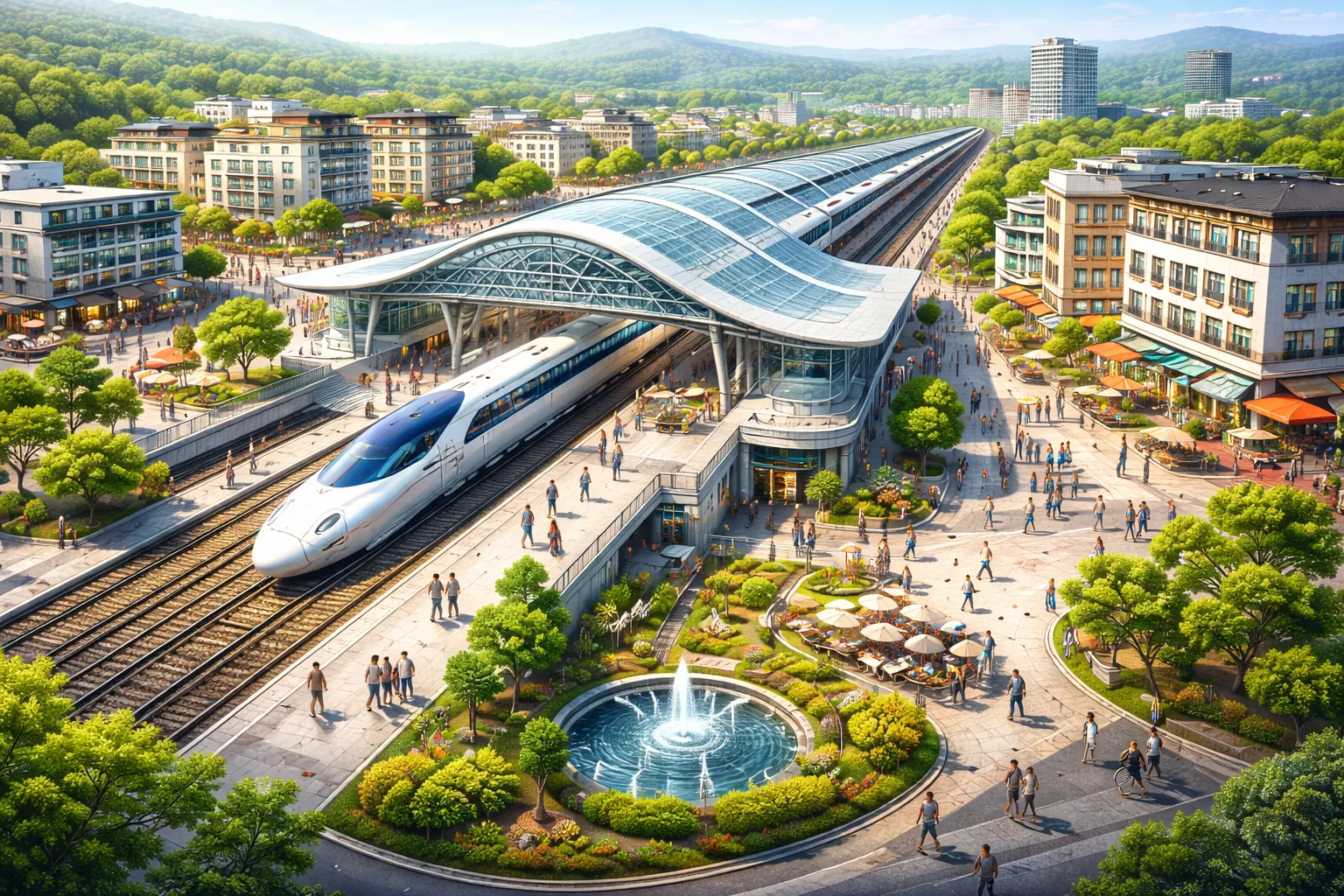
Compare this to European high-speed rail. Trains like the Eurostar or TGV move people between cities at near-airplane speeds, without the airport friction. You show up 15 minutes early, walk onto the train, and arrive in the city center. High-speed rail stations in Europe create exactly the kind of village formation that airports don't. The difference isn't the distance traveled; it's the throughput. Low-friction transportation creates villages. High-friction transportation doesn't, regardless of speed or range.
Highway Exits: The Suburban Version
In car-dependent suburbs, highway exits serve a function similar to subway stops. The areas near highway on-ramps become commercial nodes because they're the "center" of a driving radius. This is why you see the same pattern repeated: highway exit → gas station → strip mall → big box stores → apartments → single family homes radiating outward.
The difference is that car-based micro-villages are more diffuse. Instead of a tight one-mile walking radius, you get a 5-10 minute driving radius, which covers much more land. Density is lower, community bonds are weaker, and the commercial offerings are designed for drivers (parking lots, drive-throughs) rather than pedestrians. It's still a micro-village, just a less human-scaled one. This scale often feels frustrating to those without a car.
Investment Implications: Transit-Oriented Development
Understanding the micro-village model has direct implications for real estate investment. Properties within walking distance of transit stations command premiums that persist across market cycles. When new transit is built, the areas it serves see predictable appreciation. When transit service is reduced, neighborhoods decline.
This is why I pay close attention to planned transit expansions. A neighborhood that's currently inconvenient but will have a subway stop in five years is a potential value-play. This was my strategy both in Chelsea and Dorchester. In Chelsea, I bought next to the Silverline expansion, in Dorchester, next to the Fairmont line as it was being developed. The micro-village hasn't formed yet, but the infrastructure that will create it is coming. Early investors who recognize this pattern can acquire properties at pre-village prices.
Conversely, neighborhoods that rely on bus service or car access are more vulnerable. If the bus line gets cut, if gas prices spike, if parking becomes restricted, the transportation advantage disappears and so does the micro-village formation effect.
The 15-Minute City Concept
There's been recent discussion in urban planning circles about the "15-minute city" concept, where all daily needs (work, shopping, healthcare, recreation) are accessible within a 15-minute walk or bike ride. This is essentially a return to the traditional village model, enabled by mixed-use zoning and improved transit.
Cities that embrace this model will see stronger neighborhoods, higher property values in urban cores, and more resilient communities. We don't control urban planning decisions. But we can position ourselves to benefit from them. Understanding why neighborhoods form and thrive gives us an edge in identifying areas with long-term appreciation potential versus areas that are just places to pass through.
