Wrapped Assets and Cross-Chain Tokens
 Wrapped tokens are on‐chain tokens that represent assets from another network. For example, let's say you want to use your Bitcoin on Ethereum network. Normally this wouldn't be possible since they're completely different networks - closed systems that don't interact with each other.
However, you could “wrap” your Bitcoin into a new token pegged 1:1 to the original. In fact, as Circle’s SEC filing notes, until recently the only way for most users to move value between chains was via a “wrapped token,” i.e. “a tokenized representation of a particular digital asset” on another blockchain. These tokens make an asset “operable” on a new chain. For example, Wrapped Bitcoin (WBTC) is an ERC‑20 token on Ethereum that is backed 1:1 by real BTC held by a custodian. Likewise, Wrapped Ether (WETH) is simply ETH converted into the ERC‑20 token standard so it can plug into Ethereum smart contracts.
However, the term “wrapped” can be misleading. While WETH is indeed a wrapper around the native ETH asset available on-chain, many wrapped tokens rely on third parties or special bridge protocols (they're off-chain assets represented on-chain). Think of it this way: someone takes the original coin off its native chain (for example, locking Bitcoin in a vault) and then mints a new token on the target chain. Custodian “locks up” the asset on Blockchain A and creates a corresponding token on Blockchain B. That token on B is merely “a representation of the asset which actually ‘exists’ on Blockchain A.”. Wrapping is basically putting the original asset in an escrow and issuing a receipt (the wrapped token) on the other chain.
On-Chain vs. Off-Chain Tokens
It helps to distinguish on-chain native tokens from off-chain representations. A coin is on-chain when it lives and moves on its own blockchain ledger (e.g. ETH on Ethereum, BTC on Bitcoin). When we “wrap” it to another chain, the original coin is effectively off-chain to the new network. For example, WBTC on Ethereum is on-chain in Ethereum’s world, but it represents Bitcoin which is off-chain (i.e. on the Bitcoin chain). In this context we can think of “off-chain” as assets that exist outside the blockchain you’re using.
Bridging protocols let users move assets cross-chain. The typical steps are: lock the original asset on its native chain, then mint an equivalent amount of the wrapped token on the target chain. When you want your original asset back, you “unwrap” by burning (destroying) the wrapped token, releasing the locked asset.
Examples: Many well-known cryptocurrencies have wrapped versions. WBTC (on Ethereum) brings Bitcoin liquidity into Ethereum DeFi. WETH (on Ethereum) lets ETH behave like an ERC‑20 token. On Binance Smart Chain, Binance issues BTCB (Binance-pegged Bitcoin). On Polygon, assets like ETH, USDC or USDT can be bridged from Ethereum so Polygon users can hold “wrapped” versions of those coins without selling them on Ethereum. Even Solana users often get wrapped tokens (e.g. wrapped BTC or ETH via bridges like Wormhole) to use on Solana’s network. In short, wrapping tokens lets you carry the same value into another blockchain so you can use it in apps there without liquidating the asset.
Wrapped Tokens Enable Cross-Chain Transfers
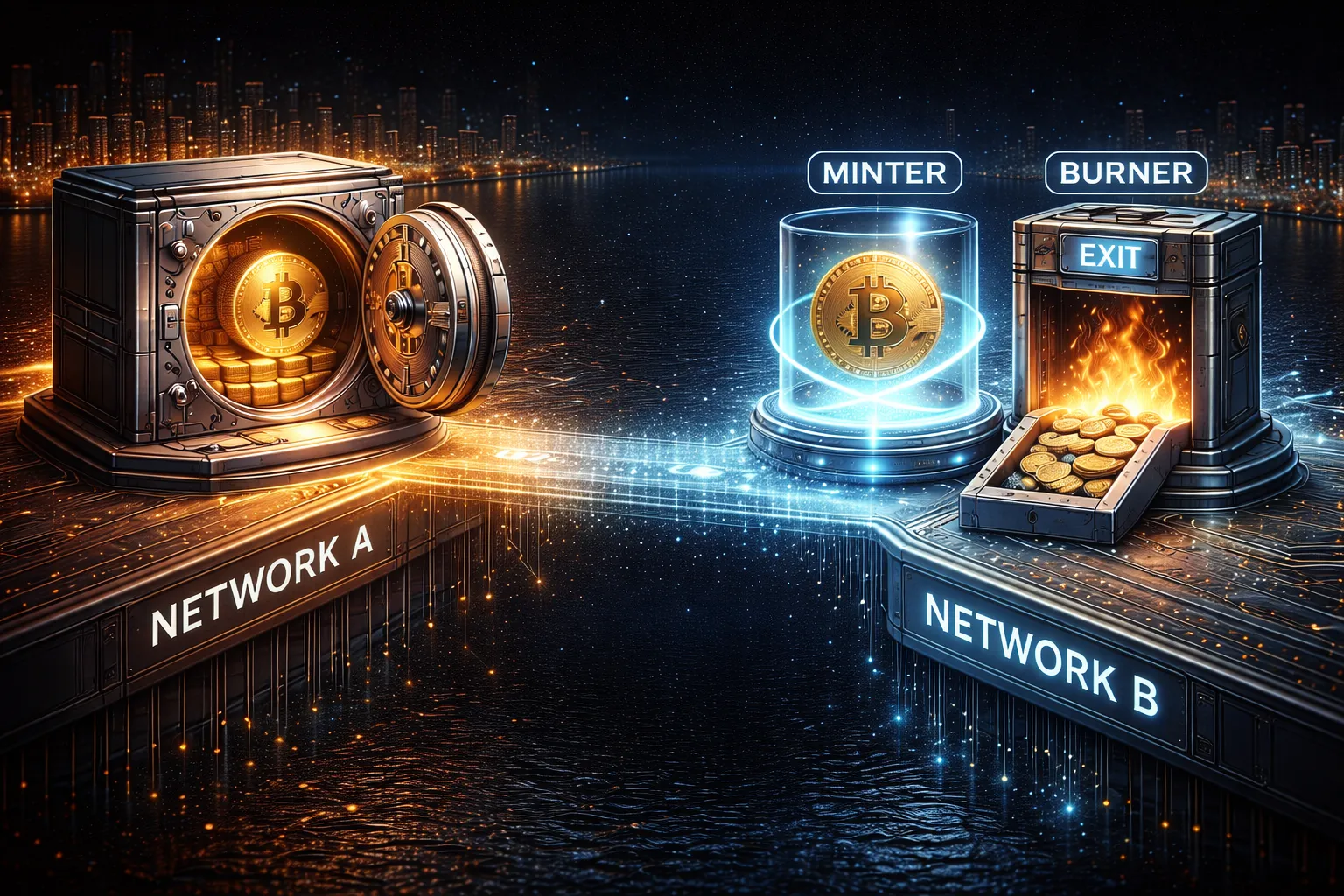 Wrapped tokens make it possible to “move” assets between networks. If you want to trade Bitcoin on an Ethereum exchange or lend it in an Ethereum DeFi protocol, you obtain WBTC and lock the same amount of real BTC in custody. You can then use WBTC on Ethereum just like any ERC‑20 token. This mechanism works similarly for any chain pair: you lock the asset on Chain A, mint a pegged token on Chain B, and later burn it to redeem on Chain A.
A typical flow might be:
- User acquires Asset A (e.g. BTC) on Chain A.
- Lock & Mint: User sends Asset A to a bridge or custodian contract on Chain A. The protocol then mints an equal amount of a Wrapped Asset A token on Chain B.
- Use on Chain B: The user now holds Wrapped Asset A on Chain B and can trade or stake it there.
- Redeem (optional): To go back, the user sends the wrapped tokens to the bridge on Chain B, which burns them and releases the original asset back on Chain A.
In practice, this lets people shift liquidity across ecosystems. For example, borrowing ETH on Polygon while still holding your ETH on Ethereum, or moving USDCoin from Ethereum to Solana to use a Solana DEX. As Circle notes, these bridges have been “cumbersome, expensive, slow, and introduce significant security and financial integrity risks” - but until better cross-chain primitives arrive, wrapped tokens are the main “bridges” available.
Risks and Historical Peg Failures
Wrapped tokens carry extra trust and failure modes. Custodian risk: Centralized wrapping (like BitGo’s WBTC) means you must trust the custodian’s reserves. CoinTracker notes that while WBTC is backed 1:1, it “requires centralized or multiparty custodians” to hold the underlying BTC, adding counterparty risk. In other words, you’re effectively trusting BitGo (or whoever) not to lose or misuse the locked BTC. If the custodian is hacked or goes insolvent, the peg can break and wrapped tokens could drop far below the original asset’s value.
Bridge hacks: Smart-contract bridges have been prime targets. For example, in September 2021 the pNetwork bridge was exploited: a bug in its code let an attacker mint extra Bitcoin tokens, stealing about 277 BTC (~$13 million). Likewise, the PolyNetwork disaster (August 2021) saw over $600 million drained across Ethereum, BSC, and Polygon before (eventually) a white-hat returned most of it. These incidents show that vulnerabilities in the lock/mint logic can instantly unpeg large amounts of wrapped assets.
Even without an outright hack, mismatches can cause depegging. For instance, if a bridge contract malfunctions or if fewer users redeem than expected, the wrapped token can stray from 1:1. (A famous non-crypto example: some algorithmic “pegged” tokens lost their peg and crashed when their backing proved insufficient – though those cases, like TerraUSD’s collapse in 2022, occurred after our cutoff.) The lesson is that wrapped assets introduce “undue risk and hacking opportunities” into what should be a simple transfer.
- Bridge vulnerability: Bridges often hold large pools of assets, making them juicy targets. In history, even billions in value have been at stake. For instance, besides pNetwork and Poly, other cross-chain exploits (notably after 2021) have repeatedly shown that a flaw can drain a bridge.
- Peg instability: If a wrapped token’s issuer mints too many tokens or fails to maintain reserves, its price can fall. In the past, some stablecoins and pegged tokens (though mostly within their own chain’s context) have lost parity under stress. Wrapped crypto carries similar risk.
- Centralization & controls: Unlike native coins, wrapped tokens can be blacklisted or frozen by the issuer. Circle (for USDC) and Tether (for USDT) have been able to freeze bridged funds. This means wrapped holders may face permissioned restrictions that “native” holders don’t.
Wrapped tokens make cross‐chain use convenient but at the cost of new trust assumptions. They let you move Bitcoin into Ethereum DeFi or send ERC-20 tokens to other chains, but you must trust the bridge/custodian. History has shown that bridges can be hacked and pegs can break. As one analysis warns, every wrapped token is only as good as the promise that it can be redeemed for the original asset. For crypto users, wrapped assets are powerful tools – but they come with risks that native on-chain coins do not.
